
Education
Skeptical: Meaning, Examples & How to Use It

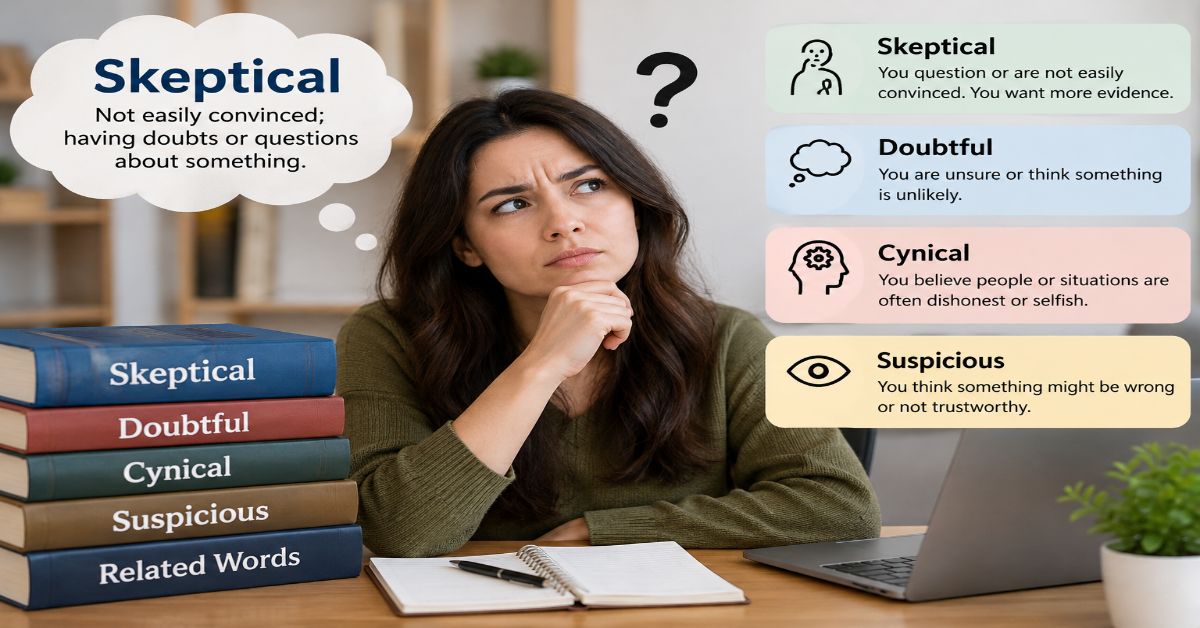
A single word can change the tone of an entire sentence. Calling someone skeptical does not necessarily mean calling them negative, rude, or difficult; it usually means they are not ready to accept a claim without enough evidence. If you are looking up “skeptical,” the practical question is often more than “What does it mean?” You may also want to know whether it is positive or negative, how it differs from words such as doubtful and cynical, and how to use it naturally in everyday English.
The clearest meaning is this: a skeptica’l person questions whether a claim, explanation, promise, or piece of information is true until there is sufficient reason to believe it. Skepticism can be useful because it encourages people to examine evidence rather than accept statements automatically. However, excessive skepticism can become unproductive when a person rejects reliable evidence simply because it conflicts with an existing belief.
This guide explains the meaning of skeptica’l in plain English, shows how the word works in sentences, compares it with closely related terms, and gives practical ways to choose the right word for a particular situation. It also covers the spelling difference between skeptica’l and sceptical, common mistakes, professional usage, and the distinction between healthy skepticism and cynicism.
Whether you are a student improving vocabulary, a writer choosing a precise adjective, or a reader trying to understand the tone of a sentence, the goal is the same: to make “skeptica’l” easier to recognize and use accurately.
What does skeptical mean?
Skeptica’l means not easily convinced that something is true, correct, genuine, or likely to happen. A skeptica’l person typically wants evidence, reasons, or reliable information before accepting a claim.
For example, if a company announces that a new product will solve a difficult problem overnight, a skeptica’l customer may ask for test results, independent reviews, or a clear explanation of how the product works. The customer is not necessarily saying the claim is false; they are withholding full belief until the evidence is stronger.
In everyday English, skeptica’l often describes a person’s attitude toward a particular statement or situation. It can also describe a general habit of questioning claims.
A useful shortcut is: “Skeptica’l” = questioning a claim because you are not yet convinced.
That is different from automatically believing something is false. Skepticism leaves room for evidence to change your mind.
Is being skeptical a good or bad thing?
Being skeptica’l can be either constructive or unhelpful, depending on how it is practiced. Healthy skepticism encourages careful thinking, while unreasonable skepticism can prevent someone from accepting well-supported information.
A useful distinction is between questioning and rejecting. A skeptica’l reader might say, “What evidence supports this?” A person who has already decided that the claim must be false might say, “Nothing could convince me.” The first position is open to evidence; the second is resistant to it.
In education, journalism, science, business, and everyday decision-making, a measured level of skepticism can reduce mistakes. It can prompt a person to check a source, compare alternatives, inspect assumptions, or ask whether a conclusion actually follows from the evidence.
At the same time, skepticism becomes less useful when it is applied inconsistently. For example, someone might demand strong evidence for information they dislike while accepting weak evidence for information they already favor. That is not careful skepticism; it is selective reasoning.
The key idea is that skepticism is an attitude of inquiry, not automatically an attitude of rejection.
| Situation | Skeptical response | What it shows |
| A new product makes a major promise | “What testing supports that claim?” | Requests evidence |
| A surprising online post appears | “Where did this information come from?” | Checks the source |
| A colleague proposes a risky plan | “What assumptions are we relying on?” | Examines reasoning |
| Reliable evidence is provided | “That evidence changes my view.” | Remains open to revision |
What is the difference between skeptical, doubtful, and cynical?
Skeptica’l, doubtful, and cynical overlap, but they are not interchangeable. The difference is often the attitude behind the lack of confidence.
Skeptica’l usually emphasizes questioning and insufficient evidence. Doubtful emphasizes uncertainty about whether something is true or will happen. Cynical often goes further by assuming that people or institutions are motivated by selfishness, dishonesty, or bad faith.
Consider the same advertisement:
Skeptical: “I want to see evidence before I believe the advertisement.”
Doubtful: “I am not sure the product will work as advertised.”
Cynical: “The company probably knows the product does not work and is trying to make money anyway.”
The first statement focuses on evidence. The second focuses on uncertainty. The third makes a negative assumption about motives.
| Word | Central idea | Typical attitude | Example |
| Skeptical | Not convinced without enough evidence | Questioning | “She was skeptical of the claim.” |
| Doubtful | Unsure something is true or likely | Uncertain | “He was doubtful that the plan would succeed.” |
| Cynical | Expects selfish or dishonest motives | Distrustful | “They were cynical about the company’s promises.” |
| Suspicious | Feels that something may be wrong or deceptive | Alert or distrustful | “The customer was suspicious of the unusual request.” |
| Disbelieving | Does not accept a claim as true | Unconvinced | “He gave a disbelieving look.” |
How do you use skeptical in a sentence?
Skeptical is an adjective, so it normally describes a person, group, attitude, expression, or reaction. Common patterns include “skeptical of,” “skeptical about,” and “skeptical that.”
“She was skeptica’l of the sales pitch.”
“The investors remained skeptica’l about the forecast.”
“I am skeptical that the repair will be completed today.”
“He gave me a skeptical look.”
“The committee was skeptical of the proposed explanation.”
“Readers may be skeptical when a headline makes an extraordinary claim.”
“Skeptical of” is especially common when the object is a claim, explanation, person, method, or promise. “Skeptical about” works naturally when discussing a subject, plan, outcome, or situation.
Skeptical of vs. skeptical about
Both constructions are grammatically acceptable, but context can make one sound more natural.
“Skeptical of” commonly points toward a specific claim, person, explanation, or proposal:
“The doctor was skeptical of the unsupported claim.”
“The manager was skeptical of the proposed solution.”
“Skeptical about” often sounds natural when the topic is a situation, possibility, plan, or expected result:
“The team was skeptical about the deadline.”
“She was skeptical about whether the investment would pay off.”
There is substantial overlap, so the choice is often a matter of natural phrasing rather than a strict rule.
What is the difference between skeptical and sceptical?
Skeptical and sceptical have the same meaning. The main difference is regional spelling.
“Skeptical” is the standard spelling in American English. “Sceptical” is the standard spelling in British English and is also used in other varieties influenced by British spelling.
The related noun also changes spelling:
American English: skeptic, skepticism
British English: sceptic, scepticism
The pronunciation and underlying meaning remain essentially the same. If you are writing for a specific publication, school, employer, or country, follow its preferred style consistently.
| Form | Common spelling | Related noun | Related noun form |
| American English | skeptical | skeptic | skepticism |
| British English | sceptical | sceptic | scepticism |
| Meaning | Same | Same | Same concept |
What are the closest synonyms for skeptical?
The best synonym depends on exactly what you want to communicate. Words such as doubtful, unconvinced, questioning, suspicious, and wary can be useful, but each carries a slightly different shade of meaning.
Questioning is often a neutral alternative when someone actively examines an idea. Unconvinced is useful when evidence has not persuaded a person. Doubtful emphasizes uncertainty. Suspicious suggests concern that something may be wrong or deceptive. Wary suggests caution because of possible risk.
“Disbelieving” can be stronger because it suggests that a person does not accept a claim. “Cynical” is also stronger in a different direction because it often implies a negative assumption about motives.
A practical synonym test is to ask what the person is actually doing:
Asking for evidence → skeptical or questioning.
Feeling uncertain → doubtful.
Refusing to accept a claim → unconvinced or disbelieving.
Suspecting deception → suspicious.
Expecting selfish motives → cynical.
Avoiding possible risk → wary.
This approach produces more precise writing than treating every synonym as interchangeable.
What does skeptical mean in professional and academic writing?
In professional and academic contexts, skeptical can signal careful evaluation rather than hostility. A reader may be described as skeptical because they want a claim supported by evidence, methodology, data, or a credible source.
For example, a report might say that stakeholders were skeptical of a proposed change. That does not necessarily mean they opposed the change. It may mean they wanted stronger evidence that the change would produce the promised outcome.
Writers should avoid using skeptical as a vague label for anyone who disagrees. Disagreement and skepticism are not identical. Someone can disagree because they have contradictory evidence, because they prefer another option, or because they interpret the facts differently.
For precise professional writing, explain the basis of the skepticism when it matters:
“The board was skeptical because the forecast did not include sensitivity analysis.”
“Customers remained skeptical after the company provided only testimonials.”
“Researchers were skeptical of the conclusion because the sample was too limited to support the claim.”
These constructions are stronger because they identify the reason for the skepticism instead of merely assigning a label.
How can you tell healthy skepticism from cynicism?
Healthy skepticism asks for evidence while remaining willing to update a conclusion. Cynicism often starts with distrust and interprets information through the assumption that people or institutions have questionable motives.
A simple test is to imagine that high-quality evidence arrives.
If a person says, “Show me the evidence, and I will reconsider,” that is compatible with healthy skepticism. If the person responds, “No evidence could prove this to me because everyone involved is lying,” the attitude has moved away from ordinary skepticism toward a more entrenched form of distrust.
Healthy skepticism also applies standards consistently. A person should be willing to scrutinize claims they like as well as claims they dislike.
This distinction is valuable in online information environments. A skeptical reader checks the source, looks for corroboration, separates facts from interpretations, and notices when a headline makes a stronger claim than the underlying material. The objective is not to distrust everything; it is to calibrate confidence to the quality of evidence.
Common mistakes when using skeptical
One common mistake is treating skeptical as a direct synonym for negative. A skeptical person may simply be unconvinced. Another mistake is using cynical when the intended meaning is merely cautious or evidence-focused.
A second mistake is confusing skepticism with certainty. “I am skeptical of the claim” does not normally mean “I know the claim is false.” The sentence communicates a lower level of confidence, not necessarily a final verdict.
A third mistake is ignoring regional spelling. Neither skeptical nor sceptical is inherently more correct in all English contexts. Choose the spelling that matches the variety of English you are using.
A fourth mistake is using the word without explaining the reason when precision matters. In formal writing, “The reviewers were skeptical” is less informative than “The reviewers were skeptical because the evidence did not address the main limitation.”
A fifth mistake is assuming that skepticism must disappear when evidence appears. Good skepticism is compatible with changing your mind. In fact, willingness to revise a conclusion is one of its most useful features.
When should you use skeptical instead of doubtful?
Use skeptical when the emphasis is on questioning a claim or asking for evidence. Use doubtful when the emphasis is on uncertainty about whether something is true, possible, or likely.
Compare:
“I am skeptical of the company’s claim.” This suggests that the claim has not been adequately supported.
“I am doubtful that the company can finish by Friday.” This emphasizes uncertainty about the outcome.
There is overlap, but the difference helps writers choose a more exact word.
If you are editing a sentence, ask whether the subject is evaluating evidence or predicting an outcome. Evidence-focused questioning usually favors skeptical; uncertainty about an outcome often favors doubtful.
Why is skepticism useful when evaluating information online?
Online information can spread quickly without giving readers enough context to judge its reliability. Skepticism provides a practical habit: pause before accepting a strong claim, identify its source, and check whether the evidence supports the exact statement being made.
A useful verification sequence is:
Identify the original source rather than relying only on a repost.
Separate the headline from the underlying claim.
Check the date and context.
Look for independent confirmation when the claim is important.
Examine whether the evidence actually supports the conclusion.
Distinguish an established fact from an opinion, prediction, or interpretation.
Update your view if stronger evidence becomes available.
This is not the same as assuming that online information is false. A skeptical approach treats credibility as something to evaluate rather than something to grant automatically.
The same principle works offline. A forwarded message, sales statement, political claim, workplace rumor, or dramatic anecdote can all be evaluated using the same basic discipline: What exactly is being claimed, and what evidence supports it?
How can writers use skeptical precisely?
Good writing uses skeptical when the word adds information about a person’s level of confidence or method of evaluation. It becomes less useful when it is inserted merely to make disagreement sound sophisticated.
For example, “The audience was skeptical of the proposal” tells the reader that the proposal did not receive immediate acceptance. A stronger version can explain why: “The audience was skeptical because the proposal did not include a cost estimate.”
Writers should also distinguish between a person’s skepticism and the truth of the claim. Saying that readers are skeptical does not establish that the readers are right or wrong. It only describes their response to the claim.
That distinction is especially important in persuasive writing. If a writer says, “Skeptics are wrong,” the next question should be: what evidence resolves the disagreement? The word itself cannot settle the issue.
A quick decision guide for choosing the right word
The following guide can help when you are deciding whether skeptical is the most accurate choice.
| If you mean… | Consider using… | Why |
| “I need evidence before I accept this.” | Skeptical | Focuses on evidence and questioning |
| “I am not sure this will happen.” | Doubtful | Focuses on uncertainty |
| “I do not accept this claim.” | Unconvinced | Focuses on lack of persuasion |
| “Something about this seems deceptive.” | Suspicious | Focuses on possible wrongdoing or deception |
| “I expect people to act for selfish reasons.” | Cynical | Focuses on motives and distrust |
| “I want to avoid possible trouble.” | Wary | Focuses on caution and risk |
Conclusion: What skeptical really communicates
Skeptical is a precise word for an attitude of questioning without automatically accepting a claim. It describes someone who is not yet convinced and wants sufficient evidence, reasoning, or credibility before reaching a conclusion.
The most important distinction is that skepticism is not the same as cynicism. A skeptical person can change their mind when strong evidence appears. That openness makes skepticism useful in everyday decisions, professional discussions, academic work, and evaluating information online.
For accurate writing, remember three points: use skeptical when the emphasis is on questioning or insufficient evidence, use doubtful when the emphasis is uncertainty, and use cynical when the emphasis is distrust of motives. Also remember that skeptical and sceptical are regional spellings of the same word.
Used carefully, skeptical does not make a person sound negative. It communicates something more useful: “I am willing to consider this, but I need a good reason to believe it.”
FAQs
Is skeptical a negative word?
Not necessarily. Skeptical is often neutral and can describe a careful approach to evidence. Its tone becomes negative mainly when the surrounding context suggests unreasonable distrust, hostility, or refusal to consider evidence.
What is the simplest meaning of skeptical?
The simplest meaning is “not easily convinced.” A skeptical person wants enough evidence or reasoning before accepting a claim as true.
Is skeptical the same as doubtful?
They are closely related but not identical. Skeptical emphasizes questioning a claim and looking for evidence, while doubtful more directly emphasizes uncertainty about whether something is true or likely.
Is skeptical the same as cynical?
No. Skepticism involves withholding belief until there is adequate support. Cynicism often involves expecting selfish, dishonest, or bad motives, so it usually carries a stronger negative implication.
Should I write skeptical or sceptical?
Use skeptical in American English and sceptical in British English. Both spellings have the same meaning, so the best choice depends on the variety of English required by your audience or style guide.
Can a skeptical person change their mind?
Yes. A healthy skeptical attitude is compatible with changing your mind when reliable evidence provides good reason to do so. Being skeptical does not mean being permanently opposed to a claim.
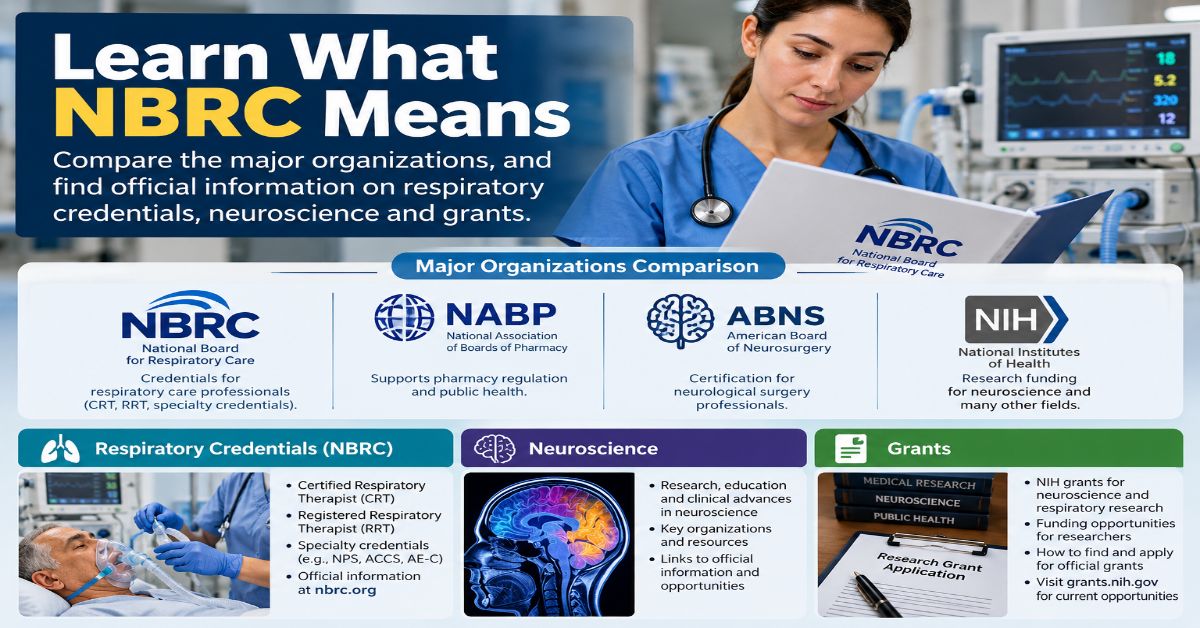
A search for “NBRC” can lead to very different destinations: a respiratory-care credentialing body in the United States, a neuroscience research institute in India, or a regional economic-development commission serving four U.S. states. If you landed on a page that does not match your goal, the problem may not be your search—it may be that the same four letters are used by several organizations.
NBRC does not have one universal meaning. The right interpretation depends on context, including whether you are researching respiratory therapy exams and credentials, brain research and academic programs, or grants for rural communities in the northern United States. This guide distinguishes the major organizations using the acronym, explains what each does, and shows how to verify that you are using the official website before relying on application instructions, deadlines, or eligibility details.
The quickest way to identify the right NBRC is to look at the surrounding terms in your search. Words such as CRT, RRT, respiratory therapist, or credential maintenance point toward the National Board for Respiratory Care. Terms such as neuroscience, Manesar, research, or doctoral study point toward India’s National Brain Research Centre. References to Catalyst grants, rural infrastructure, Maine, New Hampshire, New York, or Vermont point toward the Northern Border Regional Commission. The sections below cover these uses separately so readers can act on the information that fits their needs.
Because acronyms overlap, this article treats each organization as a distinct entity rather than assuming one meaning applies to everyone. Official websites are linked in the relevant sections; program rules and dates should always be checked there because they can change.
What does NBRC stand for?
NBRC is an acronym used by multiple organizations. Three prominent meanings are the National Board for Respiratory Care in the United States, the National Brain Research Centre in India, and the Northern Border Regional Commission in the United States. Their purposes are unrelated, so a reader should confirm the organization before following instructions or citing information.
This comparison helps match common search clues to the correct organization.
| NBRC name | Main purpose | Useful search clues |
| National Board for Respiratory Care | Credentials and examinations for respiratory-care professionals | CRT, RRT, respiratory therapist, exam |
| National Brain Research Centre | Neuroscience research and education in India | brain research, neuroscience, Manesar |
| Northern Border Regional Commission | Economic development funding in designated counties across four U.S. states | grants, rural infrastructure, Catalyst Program |
1. National Board for Respiratory Care: NBRC credentials and exams
The National Board for Respiratory Care (NBRC) is a U.S. not-for-profit credentialing organization focused on respiratory care. Its mission is to promote excellence in the profession by awarding credentials based on demonstrated competence. It develops credentialing examinations and offers credentials for respiratory therapists and pulmonary-function professionals, along with specialty credentials for qualified practitioners.
The organization is relevant to people preparing for respiratory-care examinations, professionals checking credential requirements, educators advising students, and employers seeking to understand professional qualifications. NBRC credentials are not the same thing as a college degree: education provides the foundation, while an examination and the applicable credentialing rules establish whether a candidate has met a defined competency standard.
Which respiratory-care credentials does NBRC offer?
The NBRC website lists several credentials, including Certified Respiratory Therapist (CRT), Registered Respiratory Therapist (RRT), Certified Pulmonary Function Technologist (CPFT), Registered Pulmonary Function Technologist (RPFT), and specialty credentials. Specialty areas include adult critical care, neonatal and pediatric care, sleep disorders, and asthma education. Credential names and eligibility requirements should be confirmed on the official NBRC site before making an exam plan.
The distinction between a general credential and a specialty credential matters. Entry-level credentials establish a professional foundation; specialty credentials are intended to recognize additional knowledge in a defined area. A candidate should not assume that every specialty exam is available immediately after graduation or that the eligibility requirements are identical across credentials.
How should candidates approach an NBRC exam?
Candidates should begin with the official examination page for the exact credential they want. Exam names, eligibility rules, content outlines, fees, scheduling arrangements, and maintenance requirements may differ. The NBRC works with PSI for examination administration, so official candidate instructions should take precedence over informal posts, outdated study guides, or third-party summaries.
Identify the exact credential and read its current eligibility requirements.
Review the official content outline and any candidate handbook linked from the credential page.
Confirm how the examination is scheduled, what identification is required, and which policies apply on test day.
Use reputable study materials that match the current exam outline, and build practice around the skills and concepts named there.
After passing, review the credential-maintenance rules and keep personal contact details current.
A practical example: someone searching “NBRC RRT exam” is probably not looking for a brain-research institute or a grant commission. They need the respiratory-care credential pathway, the current exam requirements, and the relevant candidate resources.
Where can readers verify NBRC respiratory-care information?
Start with the official website: https://www.nbrc.org/. Its candidate resources, credential pages, and contact information are the best starting points for current rules. For questions that are not answered online, the organization publishes its executive-office contact details on its official contact page: https://www.nbrc.org/contact/. Avoid sharing personal information or payment details through unofficial accounts that merely use the NBRC name.
2. National Brain Research Centre: NBRC in India
The National Brain Research Centre (NBRC) is an Indian institute dedicated to neuroscience research and education. It is located in Manesar, Haryana, and is an autonomous institute supported by India’s Department of Biotechnology; it also has deemed-university status. Its work brings together researchers from fields such as biology, computation, mathematics, physics, and engineering to study the brain and nervous system.
This NBRC is relevant to prospective research students, scientists, academic collaborators, and readers seeking reliable information about neuroscience projects. It is not the U.S. respiratory-care credentialing body and does not administer the NBRC respiratory-therapy examinations.
What does the National Brain Research Centre study?
Neuroscience investigates the structure and function of the nervous system, including how people sense, learn, remember, move, and respond to the world. NBRC describes research across cellular and molecular neuroscience, systems neuroscience, cognitive neuroscience, computational neuroscience, and translational neuroscience. These areas range from studying mechanisms inside individual cells to investigating cognition and developing approaches that may eventually improve understanding of neurological disorders.
The institute’s research themes include brain function in health and disease, sensory processes, learning and memory, and disorders affecting the nervous system. Such research is multidisciplinary: a project may combine biological experiments with mathematical modelling, computational analysis, imaging, or clinical collaboration. That breadth is one reason the institute may interest students from different academic backgrounds.
How can a prospective student or researcher use NBRC’s website?
A prospective applicant should first identify whether the goal is a degree, a research position, a short course, or collaboration. The entry route and required qualifications can differ. Check the institute’s current admissions announcements, faculty and research pages, and official notices rather than relying on a cached search snippet or an old social-media post.
For study: verify the current programme, eligibility, application dates, selection process, and required documents.
For research: review faculty interests and research divisions, then follow the institute’s official process for contacting a group or applying for a position.
For events and training: check the current notices for dates, registration rules, and whether the event is open to external participants.
Official starting points include the institute’s profile on the Indian government’s BRIC website at https://www.bric.nic.in/institutes/nbrc/ and the Government of India’s India Science, Technology & Innovation portal at https://www.indiascienceandtechnology.gov.in/organisationsdbt/national-brain-research-centre-nbrc. These sources identify the institution and describe its research and educational role.
3. Northern Border Regional Commission: NBRC grants and economic development
The Northern Border Regional Commission is a federal-state partnership supporting economic and community development in designated counties in Maine, New Hampshire, New York, and Vermont. Created by Congress in 2008, the commission directs resources toward regional strategies and projects intended to strengthen economic opportunity and community vitality. It is the relevant NBRC for local governments, eligible organizations, community-development groups, and other applicants exploring regional funding.
Unlike the National Board for Respiratory Care, this NBRC is not a credentialing organization. Unlike the National Brain Research Centre, it is not a neuroscience institute. The strongest clues are references to grant applications, eligible counties, infrastructure, workforce development, rural economies, or the commission’s named funding programmes.
What kinds of projects may NBRC support?
The commission’s programmes are designed to address economic and community-development needs in its service area. Programme priorities and eligible costs vary, but applicants may encounter themes such as infrastructure, workforce capacity, business and industry development, and projects that strengthen regional economic resilience. A project’s general usefulness is not enough to establish eligibility: the applicant type, location, programme objectives, match requirements, and application stage all matter.
The NBRC has described programmes including the Catalyst Program, Forest Economy Program, and Timber for Transit Program. The active portfolio, application windows, funding availability, and rules can change from year to year. Therefore, an article or government page from a previous funding cycle should be treated as background rather than proof that a programme is currently open.
How does an organization start an NBRC grant application?
The commission’s applicant resources explain that pre-applications are required for its grant programmes. A pre-application is not the same as a full application: an organization must follow the commission’s process and receive an invitation to apply before submitting a full application through its Grants Management System, where applicable.
Confirm that the proposed project and applicant are located within the programme’s eligible area and fit the current programme rules.
Read the current funding notice, applicant guidance, and programme-specific requirements from the official NBRC website.
Register or update the organization’s account and authorized contacts in the Grants Management System as directed.
Prepare the required pre-application and supporting information, paying attention to project scope, budget, outcomes, partnerships, and any match requirements.
Submit through the designated system and retain confirmation records. Do not assume that downloading a blank form or emailing it separately counts as submission.
The commission’s applicant-resources page is the key starting point: https://www.nbrc.gov/applicant-resources. Its official overview is at https://www.nbrc.gov/about-nbrc. Applicants should use these pages for the current process and deadlines, not rely on a third-party list that may describe a previous year’s programme.
How can you tell which NBRC you need?
Use the context around the acronym rather than the letters alone. This table maps common searches to the most likely organization and the next useful action.
| If your search mentions… | Likely NBRC | Best next step |
| CRT, RRT, respiratory therapy, exam eligibility | National Board for Respiratory Care | Open the credential or candidate page at nbrc.org |
| Neuroscience, brain research, Manesar, PhD | National Brain Research Centre | Check official institute admissions and research notices |
| Catalyst, grant, eligible counties, rural development | Northern Border Regional Commission | Read current programme guidance and applicant resources |
| Only “NBRC,” with no other context | Ambiguous | Add a location, profession, programme, or goal to the search |
Common mistakes to avoid when researching NBRC
Assuming the acronym identifies one organization
The most common mistake is treating the first search result as the only possible meaning. Check the full organization name, country, official domain, and purpose before acting. A credentialing rule from the U.S. respiratory-care organization will not answer a question about Indian neuroscience admissions or regional grants.
Relying on old deadlines or third-party summaries
Exam rules, academic admissions, and grant cycles are all time-sensitive. A page may remain visible after its deadline has passed. Look for a current date, programme year, official notice, or candidate handbook, and confirm important requirements directly with the organization.
Confusing a credential, an academic qualification, and a grant
These are different kinds of institutional activity. A professional credential records that a person has met a competency standard; an academic programme provides education or research training; a grant programme allocates funding under defined eligibility and selection rules. The shared acronym does not make their processes interchangeable.
Treating search snippets as complete instructions
Search-result summaries can omit exceptions, eligibility conditions, or later updates. Use snippets to identify the likely page, then read the official source itself. Before paying a fee, submitting sensitive documents, or committing project resources, confirm that the destination is an official channel.
A quick verification checklist
Before using any NBRC information, check these five details:
Full name: Does the page spell out the organization’s complete name?
Location: Does the country, state, or city match your intended organization?
Purpose: Is the page about credentials, neuroscience, or economic-development funding?
Date: Are the deadline, exam rules, or programme requirements current?
Official source: Is the information published by the organization or a relevant government agency?
This checklist is simple, but it prevents a costly category error—such as preparing for the wrong examination, contacting an unrelated institute, or using a grant form from a past funding cycle.
Conclusion: Start with the full name, not just NBRC
NBRC is a useful search term only when paired with the right context. The National Board for Respiratory Care supports professional credentialing in respiratory care; India’s National Brain Research Centre advances neuroscience research and education; and the Northern Border Regional Commission supports economic development in designated communities across four U.S. states. Each serves a different audience and has its own official procedures.
For the fastest route to an accurate answer, add the goal or location to the acronym, open the official site, and verify current requirements before acting. That small step makes the search more precise and helps ensure that the information you use actually belongs to the organization you intended.
Frequently asked questions about NBRC
Is NBRC a medical certification organization?
It can refer to one: the National Board for Respiratory Care in the United States awards respiratory-care credentials. However, NBRC also refers to unrelated organizations, including a neuroscience institute in India and a regional development commission.
What is the official website for the National Board for Respiratory Care?
The official website is https://www.nbrc.org/. Use its credential, examination, candidate-resource, and contact pages to verify current information.
Where is the National Brain Research Centre located?
The National Brain Research Centre is located in Manesar, Haryana, India. Government institute profiles describe it as a centre for neuroscience research and education.
Can anyone apply for an NBRC grant?
No. For the Northern Border Regional Commission, eligibility depends on the current programme rules, applicant type, project, and designated service area. Review the official applicant resources before beginning an application.
Does NBRC mean the same thing in India and the United States?
No. The National Brain Research Centre is in India, while the National Board for Respiratory Care and Northern Border Regional Commission are U.S.-based organizations with different responsibilities.
How do I make an NBRC search more specific?
Add a clear clue such as “RRT exam,” “neuroscience admissions,” or “Catalyst grant.” Including the location or the full organization name also helps distinguish official information from unrelated results.

A student can earn strong grades and still feel uncertain about what to study next. Another may enjoy building things, solving visual puzzles, or organizing complex tasks without realizing those habits connect to careers they have never considered. YouScience is designed to help make those less-obvious strengths visible. Its Aptitude & Career Discovery experience combines performance-based exercises with interest information to suggest career directions and education pathways.
In brief, YouScience is a career and college-readiness platform that measures selected aptitudes through short, game-like exercises and combines the results with a person’s stated interests. It then presents career matches and related learning pathways for exploration. The results are a starting point for informed conversations—not a guarantee of job success or a command to choose one occupation.
This guide explains what the platform does, what its assessment measures, how to approach the exercises, and how students, families, educators, and adults considering a career change can use the results responsibly. Product details can change, so readers should confirm current access, features, and pricing directly with YouScience or the school or organization providing the account.
The central idea is practical: career decisions become stronger when people consider not only what they like, but also what kinds of tasks come naturally, what skills they are willing to build, and what real-world opportunities exist. YouScience can help organize that conversation—but the best decisions still combine assessment results with experience, research, and human judgment.
What Is YouScience?
YouScience is an education and career-readiness technology provider. Its Brightpath platform brings together tools for discovering aptitudes, exploring careers, planning education, and connecting learning with workforce opportunities. One of its best-known experiences, Aptitude & Career Discovery, uses performance-based activities to help users identify patterns in how they solve problems.
An aptitude is a natural capacity or potential for learning and performing certain kinds of tasks. It differs from a skill, which is developed through practice; an interest, which reflects what someone enjoys or wants to explore; and a personality trait, which describes typical patterns of behavior. These factors can influence one another, but they are not interchangeable.
YouScience says its career-matching process compares a user’s aptitude profile and interests with the aptitude requirements associated with careers. The company reports using occupational information, including the U.S. Department of Labor’s O*NET career database, as part of this matching approach. Because the matching method is proprietary, users should treat the results as recommendations to investigate rather than a fully transparent prediction.
The company’s current materials describe a broader platform than a single test: schools may use features for career discovery, education planning, industry certifications, and work-based learning. The exact tools available depend on the product, account, and institution.
How Does YouScience Work?
The process typically begins when a school, counselor, or other provider gives a student access. Users complete a series of brief exercises designed to measure different aptitudes, along with questions about interests. Results are then presented in a profile that can be used to explore career matches and potential education routes.
1. Complete the aptitude exercises
The full Aptitude & Career Discovery assessment for students in ninth grade and above is described by YouScience as 11 exercises, often taking roughly 90 minutes in total. Each activity is shorter than a traditional long-form exam, and the company recommends splitting the work across multiple sessions if needed. The platform saves completed exercises so a user can return later.
2. Review the aptitude profile
The results describe areas of relative strength across measured aptitudes. A result is not a grade, diagnosis, or verdict on intelligence. It is a structured snapshot that can help a user notice which tasks may feel more natural and which may require more practice or support.
3. Compare aptitudes with interests
Interests help add personal context. A person may have strong potential in an area they have never explored, while a favorite subject may not appear among their strongest aptitude matches. Neither result should automatically override the other. Instead, the contrast creates useful questions: What is appealing about this field? Would the day-to-day work suit me? Am I willing to build the skills it requires?
4. Explore careers and education routes
YouScience connects profiles to career options and related pathways. Depending on the version and account, users may explore majors, colleges, technical programs, certifications, and employers. The most useful next step is to move from a match label to evidence: typical duties, entry requirements, training cost, pay ranges, local demand, and opportunities to try the work.
For an overview of the company’s description of its product and assessment, consult the official [Aptitude & Career Discovery FAQs](https://www.youscience.com/discovery-faqs/) and [Brightpath Discovery page](https://www.youscience.com/education/brightpath/discovery/).
Which Aptitudes Does YouScience Measure?
YouScience lists nine core aptitudes in its full Aptitude & Career Discovery experience. These include idea generation, numerical reasoning, spatial visualization, sequential reasoning, inductive reasoning, visual comparison speed, timeframe orientation, vocabulary, and work approach. Optional activities may assess additional areas such as numerical computation, associative memory, hand-eye coordination, visual memory, and pattern memory.
The following table explains these labels in plain language. These are practical interpretations of the terms, not a substitute for the platform’s own descriptions of an individual result.
| Aptitude label | Plain-language meaning | Example of a related task |
| Idea generation | Producing multiple possible ideas or approaches | Brainstorming different ways to improve a process |
| Numerical reasoning | Recognizing relationships in numerical information | Comparing quantities or interpreting number patterns |
| Spatial visualization | Mentally manipulating shapes or objects | Understanding a diagram or how parts fit together |
| Sequential reasoning | Following steps and recognizing order | Working through a process with dependencies |
| Inductive reasoning | Inferring a general pattern from examples | Noticing a rule in a set of observations |
| Visual comparison speed | Quickly spotting visual similarities and differences | Checking items for mismatches |
| Timeframe orientation | Approaching tasks with a sense of time and timing | Planning work against a deadline |
| Vocabulary | Understanding and working with words | Interpreting written instructions |
| Work approach | A pattern in how someone tends to approach tasks | Considering preferences for task structure and execution |
Aptitude labels are easier to use when linked to real tasks. For example, a strong spatial-visualization result may prompt someone to explore design, drafting, manufacturing, or technical fields—but it does not prove that any one job is suitable. Those careers also require training, communication, reliability, and other abilities.
The assessment should also be understood within its limits. It samples particular abilities through particular exercises. It cannot capture every strength, life circumstance, value, or experience that matters to a career decision.
YouScience vs. Interest Tests, Personality Quizzes, and Grades
Career tools often look similar because they all produce descriptions or recommendations. Their underlying questions, however, can differ. This comparison clarifies what each type of tool contributes.
| Tool type | Main question | Useful contribution | Important limitation |
| YouScience aptitude discovery | Which kinds of tasks may come naturally to me? | Adds performance-based information to career exploration | Does not determine future success or replace training |
| Interest inventory | Which subjects or activities appeal to me? | Highlights motivation and curiosity | Interests can reflect limited exposure |
| Personality questionnaire | How do I tend to think, feel, or interact? | Supports reflection on work environments and collaboration | Personality is not a direct measure of job ability |
| Grades and achievement tests | What knowledge or academic performance have I demonstrated? | Shows learning outcomes and preparation in particular subjects | May miss strengths that have not yet been taught or assessed |
| Work experience or job shadowing | How do I respond to the real work? | Tests assumptions against day-to-day reality | Access and experience can be uneven |
The strongest approach combines methods. A student who receives a career match in engineering can compare it with math and science coursework, talk with an engineer, inspect program prerequisites, and try a small design project. Someone who gets a match in a people-focused field can volunteer, interview a professional, or take an introductory course.
No single assessment should be treated as an objective ranking of a person’s worth or potential. A result is information to interpret—not a label to live up to.
Who Can Benefit From YouScience?
Middle- and high-school students
Students may use aptitude discovery before choosing electives, career and technical education pathways, or postsecondary plans. YouScience describes a middle-school version for grades seven and eight that measures a smaller set of aptitudes and presents career clusters; the fuller experience is intended for ninth grade and beyond. Schools determine which version and features are available.
Families and caregivers
Families can use the results as a conversation starter rather than a decision-making shortcut. Ask the student which results feel accurate, which are surprising, and which careers they want to investigate. Avoid turning a profile into pressure to select a particular major or occupation.
Educators and career counselors
Educators can use profiles to structure discussions, identify unexplored options, and connect career interests to courses or technical pathways. The platform’s reporting and planning features may help schools coordinate guidance at scale, but a counselor’s context and follow-up remain important.
Adults exploring a career change
Adults may find the profile useful when returning to work, reconsidering a major, or exploring a different field. Their existing experience, financial responsibilities, transferable skills, and preferred working conditions should carry substantial weight. An aptitude result can suggest possibilities, but it cannot tell an adult whether a change is financially or personally feasible.
How to Get Better Value From Your YouScience Results
There is no recommended way to study for a natural-aptitude assessment. YouScience advises users not to use external aids or try to game the exercises, because doing so can distort the profile. Preparation should focus on creating fair conditions for the assessment, not rehearsing answers.
Choose a quiet place and a time when you are alert. Close unrelated tabs and silence notifications.
Read each instruction carefully before starting an exercise. Follow the rules provided by the platform.
Work independently and avoid external aids. The goal is to measure your own performance under the stated conditions.
Take breaks between exercises if the platform permits. Finish an exercise before stepping away.
Review the full profile, not only the top-ranked result. A balanced picture includes strengths, less-developed areas, and interests.
Write down three matches that appeal to you and one that surprises you. Investigate each rather than accepting or dismissing it immediately.
Discuss results with a counselor, teacher, or trusted adult who can help connect them to real courses and opportunities.
If a result seems inconsistent with lived experience, do not assume either the assessment or the person is wrong. Consider whether the exercise conditions were distracting, whether the label is being interpreted correctly, and whether the result describes a narrow task rather than an entire occupation.
What Are the Main Benefits and Limitations?
YouScience’s main potential benefit is that it can broaden career exploration beyond familiar job titles and self-reported interests. It gives students a structured way to discuss aptitude, interests, and possible pathways. For schools, a shared platform can help connect career conversations to courses, credentials, and postsecondary options.
The value depends on what happens after the assessment. A list of matches without follow-up can be interesting but not especially actionable. A list paired with career research, course planning, a professional conversation, and a small real-world trial can lead to more useful decisions.
| Potential benefit | What to verify or watch for |
| Discover less familiar career options | Check what the job involves each day and whether it interests you |
| Connect strengths to learning pathways | Confirm admissions, prerequisites, certification rules, and costs |
| Support counselor conversations | Ensure a trained person helps interpret results in context |
| Organize school-level career planning | Ask which reports, features, and student supports are included in the school’s plan |
| Encourage reflection and confidence | Avoid treating a profile as fixed, exhaustive, or predictive of guaranteed outcomes |
A key limitation is that the career-matching algorithm is proprietary, so outsiders cannot independently reconstruct every match from the public description alone. Another is that occupational conditions change: salary, demand, licensing, and education requirements vary by location and over time. Users should validate those details with current local sources.
The assessment is also not a replacement for professional counseling. YouScience itself notes that the profile can provide a foundation for career decisions but does not replace the individualized support of a qualified career counselor. It should not be used as the sole basis for high-stakes decisions about a student’s future.
Is YouScience Free, and How Do You Get Access?
YouScience does not publish one universal public price for every school and individual use case on its main quote page. Access may be arranged through a school, district, educational consultant, or another organization. If you are a student, first ask your teacher or counselor whether your institution provides access. If you are a parent, ask which version is licensed, what the student can see, and who can access the results.
For an individual or institution considering a purchase, request current pricing and confirm the package in writing. Ask whether career discovery, postsecondary planning, certifications, educator reporting, parent access, and work-based learning are included or sold separately. Also ask about account duration, support, accessibility, data retention, and the process for correcting account or profile information.
You can start with the official [YouScience website](https://www.youscience.com/) and its [request-a-quote page](https://www.youscience.com/quote/). Pricing and included features can change, so avoid relying on old third-party figures without confirmation.
Privacy, Fairness, and Responsible Use
Career profiles can contain personal information about a student’s abilities, interests, and plans. Before using a school account, ask who can view the results, how they are shared, how long they are retained, and what choices the student or family has. YouScience’s FAQ says school or counselor purchasers may have access to the profiles they administer, so the practical privacy arrangement depends on the account and provider.
Fair use also means avoiding assumptions about gender, family income, disability, background, or prior exposure. A profile can introduce an option, but access to training and opportunity still depends on resources, local availability, support, and individual choice. Schools should use results to expand possibilities—not to sort students into narrow tracks or lower expectations.
For a careful decision, keep the profile alongside other evidence: academic performance, practical experience, student preferences, accessibility needs, labor-market research, and conversations with people who do the work.
Conclusion: Treat YouScience as a Starting Point, Not a Verdict
YouScience can help students and adults see connections between natural aptitudes, interests, careers, and education pathways that might otherwise remain hidden. Its most useful contribution is not a single perfect job match; it is a more informed set of questions and options.
Use the results to choose what to investigate next. Compare matches with real job duties, required training, costs, working conditions, and opportunities to gain experience. Ask a counselor to help interpret surprising results, and revisit decisions as interests and circumstances evolve. A career assessment is valuable when it leads to thoughtful exploration and concrete next steps—not when it makes the decision for you.
Frequently Asked Questions About YouScience
How long does the YouScience assessment take?
YouScience says the full Aptitude & Career Discovery assessment for ninth grade and above includes 11 exercises and takes roughly 90 minutes overall. The company recommends completing it over two or more sessions if that is more comfortable.
Can you study for the YouScience assessment?
YouScience advises against studying, cheating, or using external aids. The exercises are intended to measure natural aptitudes, so outside assistance may make the results less representative of your own performance.
Does YouScience tell you exactly what career to choose?
No. It suggests career options based on a combination of aptitude and interest information. Users should compare those suggestions with job duties, training requirements, values, circumstances, and real-world experience.
Is YouScience only for high-school students?
No. The platform is strongly used in education, and the company also describes applications for adults exploring career changes or other work and life choices. Access and available features depend on the provider and product.
Can parents see a student’s YouScience results?
Access depends on how the school or organization has set up its account. YouScience states that schools and counselors who purchase profiles for students or clients have access to those results. Ask the institution about its current sharing and privacy practices.
How do I access YouScience or find the price?
Students should ask their school counselor or teacher whether access is provided. Individuals and institutions can contact YouScience through its official website to confirm eligibility, current pricing, and which features are included.

A conversation can go wrong before anyone realizes a word has been misunderstood. A patient may not fully understand discharge instructions, a witness may miss the meaning of a legal question, or a customer may abandon a support call because help is unavailable in their language. Language Services Associates (LSA) is a language-services provider that helps organizations address these situations through interpreting, translation, localization, sign-language support, and related services. This guide explains what Language Services Associates offers, who may benefit, and what to check before choosing a language-services partner.
The search intent behind “language services associates” is primarily navigational and commercial: readers may be trying to identify the company, understand its capabilities, explore its industry experience, or decide whether to contact it. LSA says it was founded in 1991 and provides language support across hundreds of languages, with options that include telephone, video, and onsite interpreting as well as translation and localization. The right service depends less on the name of the provider than on the communication task, the sensitivity of the information, the language pair, and the setting in which the conversation will happen.
A useful way to assess any provider is to start with the moment communication must succeed. Is a trained interpreter needed during a live appointment, or does a document need to be translated for use across several countries? Is the content routine, or does a mistake create legal, safety, financial, or clinical risk? By matching the service to the use case—and confirming qualifications, privacy practices, availability, and pricing in advance—organizations can make a more informed decision. The sections below describe LSA’s published service categories and offer a practical framework for evaluating them without assuming that one provider or delivery method fits every situation.
What is Language Services Associates?
Language Services Associates, commonly called LSA, is a language-services company headquartered in Horsham, Pennsylvania. The company’s public materials describe a business founded in 1991 that supports communication between organizations and people who speak different languages. Its work spans interpreting for live conversations, translation and localization for written or recorded content, American Sign Language (ASL) services, and language assessment.
Interpreting and translation are related but distinct disciplines. Interpreters convey spoken or signed communication between people in real time, while translators render written content into another language. Localization adapts content to the language, conventions, and expectations of a particular audience or market. A project may need one service or a combination: a healthcare organization, for example, might use an interpreter for a consultation and a translator for patient-facing forms.
LSA describes its network as including qualified interpreters and translators with industry-specific experience. Its website also highlights quality assurance, technology, and options for remote access. These are provider-reported capabilities; buyers should still confirm the exact languages, service levels, qualifications, and contractual terms required for their own organization.
Which services does Language Services Associates provide?
LSA lists several ways to arrange language support. The most suitable option depends on whether the communication is live or recorded, whether participants are together physically, and how much preparation the subject requires.
| Service | Best suited to | Questions to confirm |
| Over-the-phone interpreting | Immediate or scheduled conversations where audio is sufficient | Language availability, connection process, minimum charges, and after-hours access |
| Video remote interpreting | Remote conversations where facial expression or visual context helps | Platform compatibility, device requirements, privacy, and backup procedures |
| Onsite interpreting | Meetings, appointments, or proceedings where an interpreter must be physically present | Geographic coverage, travel fees, lead time, and specialist credentials |
| Translation and localization | Documents, websites, applications, media, and customer communications | Review process, terminology management, formatting, and locale requirements |
| American Sign Language | Communication with Deaf or hard-of-hearing participants who use ASL | Interpreter credentials, setting-specific experience, and onsite or remote options |
| Language assessment and testing | Evaluating bilingual staff before assigning language-dependent duties | Assessment criteria, proficiency levels, and how results will be used |
These categories are not interchangeable. A phone interpreter may be appropriate for a short scheduling call but less suitable for a conversation that relies on visual information. A translated document may support a process, but it cannot replace an interpreter when participants need to ask questions and respond in real time.
How does phone interpreting work?
Phone interpreting connects participants with an interpreter through a telephone or supported calling system. It can be useful when a conversation is urgent, participants are in different locations, or video is not practical. Before a session, staff should know how to request the language, introduce each participant, and explain the purpose of the call. During the conversation, speakers should use short, complete statements and pause for interpretation rather than speaking over one another.
Phone service is not automatically the best choice for every situation. If a discussion includes diagrams, forms, demonstrations, or emotionally complex information, video or onsite support may be more effective. Organizations should also confirm how interpreters are reached outside normal business hours and what happens if the requested language is not immediately available.
When is video or onsite interpreting better?
Video interpreting allows participants to communicate remotely while seeing one another and the interpreter. It may be useful for telehealth, virtual appointments, service counters, and meetings where visual cues improve understanding. Reliable connectivity, a suitable camera position, clear audio, and a private room all affect the quality of the session.
Onsite interpreting places the interpreter in the same physical setting as the participants. It can suit complex appointments, legal proceedings, community meetings, or interactions where physical presence is important. Onsite arrangements generally require more scheduling than remote sessions, so buyers should check travel coverage, cancellation terms, and the time needed to secure a specialist.
Which industries can benefit from LSA’s language services?
Language support is most valuable when people must understand information accurately to make a decision, receive a service, or participate fairly. LSA highlights work across healthcare, legal services, government, finance, insurance, education, nonprofit organizations, manufacturing, hospitality, and other commercial settings. The specific service and qualifications should be matched to each sector’s risks.
Healthcare and behavioral health
In healthcare, an interpreter may help a clinician gather a patient’s history, explain a procedure, discuss follow-up care, or answer questions during a telehealth appointment. Clear interpretation supports informed participation, but it does not replace the clinician’s responsibility to explain medical information. Organizations should verify relevant healthcare experience, confidentiality expectations, and procedures for urgent or sensitive conversations.
For written materials, translation and localization can make appointment instructions, consent information, and patient education easier to understand. Documents should be reviewed for meaning, readability, and consistency with the source. When a translation is used in a regulated or high-risk workflow, the organization should define who approves it and how revisions are controlled.
Legal and government settings
Legal communication can involve specialized vocabulary, procedural rules, and consequences for the people involved. LSA advertises interpreting for courtroom appearances, depositions, client intake, witness preparation, and related legal work. A prospective client should verify whether the interpreter meets the specific court, jurisdiction, or agency requirements; general bilingual ability alone may not be sufficient.
Government and community organizations may also need language access for public services, interviews, hearings, and outreach. Planning ahead helps agencies identify frequently requested languages, establish an escalation route for uncommon languages, and document how language support was provided.
Business, finance, insurance, and customer support
Businesses may use interpreters for customer service, claims discussions, account questions, sales conversations, employee meetings, and supplier calls. Translation and localization can support contracts, disclosures, websites, applications, product instructions, and marketing content. In finance or insurance, organizations should pay particular attention to terminology, privacy, and how staff verify that a customer has understood important choices.
The operational benefit is not simply that a conversation can happen. A well-designed language-access process can reduce repeated calls, prevent avoidable confusion, and help customers complete a task correctly. These outcomes should be measured against the organization’s own baseline rather than assumed from a provider’s marketing claims.
How should you choose the right LSA service?
Start with the communication requirement, then compare the provider’s capabilities against it. A concise requirements brief makes it easier to request a relevant quote and prevents a mismatch between the service ordered and the work that must be done.
| Decision factor | What to establish | Why it matters |
| Language and dialect | Exact language, dialect, and any regional preference | Language labels alone may not capture a participant’s needs |
| Subject matter | Healthcare, legal, financial, technical, or general conversation | Specialized terminology and context can change the qualification required |
| Delivery method | Phone, video, onsite, or written translation | The format should fit the interaction, not merely the easiest booking option |
| Timing and volume | One appointment, scheduled sessions, or recurring demand | Availability and pricing can depend on frequency and lead time |
| Quality assurance | Qualification checks, feedback, escalation, and review | A defined process helps identify and correct recurring issues |
| Security and privacy | Data handling, confidentiality, access, and retention terms | Sensitive conversations and documents need appropriate safeguards |
| Commercial terms | Rates, minimums, travel, cancellations, and invoicing | The total cost may include more than the headline hourly rate |
Use these factors when contacting LSA or any alternative provider. Ask for written confirmation of the service scope and the terms that matter to your workflow. If a provider cannot confirm a required credential, language, or security control, do not assume it is included.
What should organizations ask before signing an agreement?
A short procurement conversation can reveal whether a language-services provider is ready for the work. Ask practical questions and request documentation where the stakes justify it.
Which languages and dialects are available for the specific service and time window?
How are interpreters and translators screened, assessed, and matched to specialist assignments?
Can the provider support scheduled sessions as well as urgent or after-hours requests?
What technical requirements apply to phone, video, telehealth, or other integrations?
How are complaints, missed appointments, terminology issues, and service failures investigated?
What confidentiality, security, and data-retention terms apply to calls, recordings, documents, and platform access?
How are fees calculated, including minimum session lengths, travel, cancellation, rush work, and revisions?
Can the provider describe service-level reporting and provide references or a relevant case study?
It is also sensible to run a controlled pilot before expanding a service across an entire organization. Select a representative set of interactions, brief staff on how to access support, and gather feedback from both employees and service users. Measure indicators such as connection time, successful completion, repeat contacts, user feedback, and documented quality issues. Keep the pilot’s criteria consistent so the organization can compare results meaningfully.
How much do Language Services Associates services cost?
A universal price cannot be stated responsibly without knowing the language, delivery method, duration, subject matter, location, urgency, and contract arrangement. Phone and video interpreting may be priced differently from onsite appointments, while translation projects may depend on word count, file complexity, language pair, review requirements, and deadlines. LSA’s public service pages do not establish one price that applies to every assignment.
To compare quotes, give each provider the same scope. Specify the language and dialect, whether the request is live or written, the expected duration or volume, the subject area, the deadline, and any security or integration requirements. Ask for a breakdown of minimum charges, cancellation fees, travel expenses, rush fees, revisions, and any recurring platform costs. A lower base rate is not necessarily the lower total cost if the service does not fit the task or requires repeated work.
For recurring needs, estimate expected monthly volume and ask how the rate changes with scheduled use or a service agreement. For occasional high-stakes assignments, prioritize verified qualifications and availability alongside cost. The aim is to compare equivalent services rather than choosing solely by the smallest quoted number.
How do AI and human language services fit together?
Language technology can speed up parts of a multilingual workflow, but the appropriate level of human review depends on the content and its consequences. LSA lists Machine Translation+—machine translation enhanced by human post-editing—and AI video dubbing among its offerings. These approaches can be useful for some content workflows, but buyers should ask exactly which stages are automated and which are reviewed by a qualified person.
For low-risk, high-volume content, machine-assisted translation may help teams produce drafts efficiently. Public-facing instructions, legal documents, clinical information, financial disclosures, and other high-impact material call for stricter review and approval. AI-generated speech or dubbing should also be checked for meaning, pronunciation, timing, names, and cultural appropriateness.
A practical policy classifies content by risk before selecting a workflow. Define what may be machine-translated, what requires human post-editing, what needs independent review, and what must be handled by a qualified interpreter in a live exchange. Do not send confidential or regulated information to a technology platform until its data-use and retention terms have been reviewed.
Common mistakes to avoid when buying language services
Several preventable mistakes can weaken an otherwise sound language-access program:
Treating any bilingual employee as a substitute for a qualified interpreter in a sensitive or specialized setting.
Choosing a delivery method before considering whether the conversation depends on visual information or physical presence.
Booking only for the expected appointment length without allowing time for introductions, clarification, and interpretation.
Assuming a translated document is ready to publish without checking layout, terminology, audience, and approval requirements.
Failing to brief staff on how to connect an interpreter or what to do if the connection fails.
Evaluating a provider only on cost while ignoring qualifications, reliability, privacy, and issue resolution.
A written language-access procedure can reduce these problems. It should explain who can request support, how staff identify the required language, which service channels are approved, how urgent requests are handled, and how concerns are reported. Review the procedure periodically using real service data and feedback.
Conclusion: Is Language Services Associates worth considering?
Language Services Associates is an established provider of interpreting, translation, localization, ASL, language assessment, and related language solutions. Its published offerings cover remote and onsite communication as well as written and media content, making it a potential option for organizations with multilingual customers, patients, clients, or employees. Whether it is the right fit depends on the precise language pair, specialist requirements, availability, security needs, service quality, and commercial terms.
Before choosing LSA, define the task, request details for the exact service, verify qualifications and privacy arrangements, and compare complete quotes. A small pilot can show whether the process works in practice. The best language-services partner is one that makes communication clearer and more accessible while fitting the organization’s operational and compliance requirements.
Frequently Asked Questions
Is Language Services Associates a translation company or an interpreting company?
It provides both. Its published capabilities include interpreting by phone, video, and onsite, as well as translation and localization, American Sign Language, language assessment, and selected machine-assisted media services.
Where is Language Services Associates based?
LSA lists its headquarters in Horsham, Pennsylvania, in the United States. Contact the company directly to confirm current contact details and the right team for your region or service request.
Does LSA offer interpreting around the clock?
LSA advertises over-the-phone interpreting as available 24 hours a day, seven days a week, year-round. Confirm the requested language, service channel, and any account-specific arrangements before relying on availability for a critical event.
Can organizations use LSA for legal or healthcare appointments?
LSA advertises language services for legal and healthcare settings. Organizations should verify the assigned linguist’s relevant experience and any credentials or rules required by the court, agency, healthcare facility, or jurisdiction.
Does LSA provide American Sign Language interpreting?
Yes. LSA lists ASL services, including in-person and remote options, and refers to RID-certified interpreters. Confirm the credentials and format needed for the specific event.
How can I get a quote from Language Services Associates?
Use LSA’s official website to contact the company and describe the language, service type, subject area, expected volume, timing, and any security or integration requirements. Request written pricing and confirm additional charges before approving the work.
-

 Guide2 months ago
Voozon.com Guide: What It Is and How It Works
-

 General2 months ago
Spanking Stories: A Reader’s Guide to Themes, Tags and Safer Choices
-
 Technology2 months ago
techtrendery.com: Website Guide for 2026
-

 General2 months ago
SABS Framework Description Paragraph: Practical Guide
-

 Technology3 months ago
Coomer.su Explained: Architecture, Data Flow, API Changes and Resilient Client Design
-

 Guide3 months ago
How to Run a Marathon: A Practical First-Marathon Guide
-

 Technology3 months ago
Listcrawler: How List Crawlers Extract Structured Web Data
-

 General3 months ago
Socialmediagirls Explained: Safety, Privacy, Forum Structure, Leaks and Rules