
Business
WebBanking Comerica Web: Current Access Guide

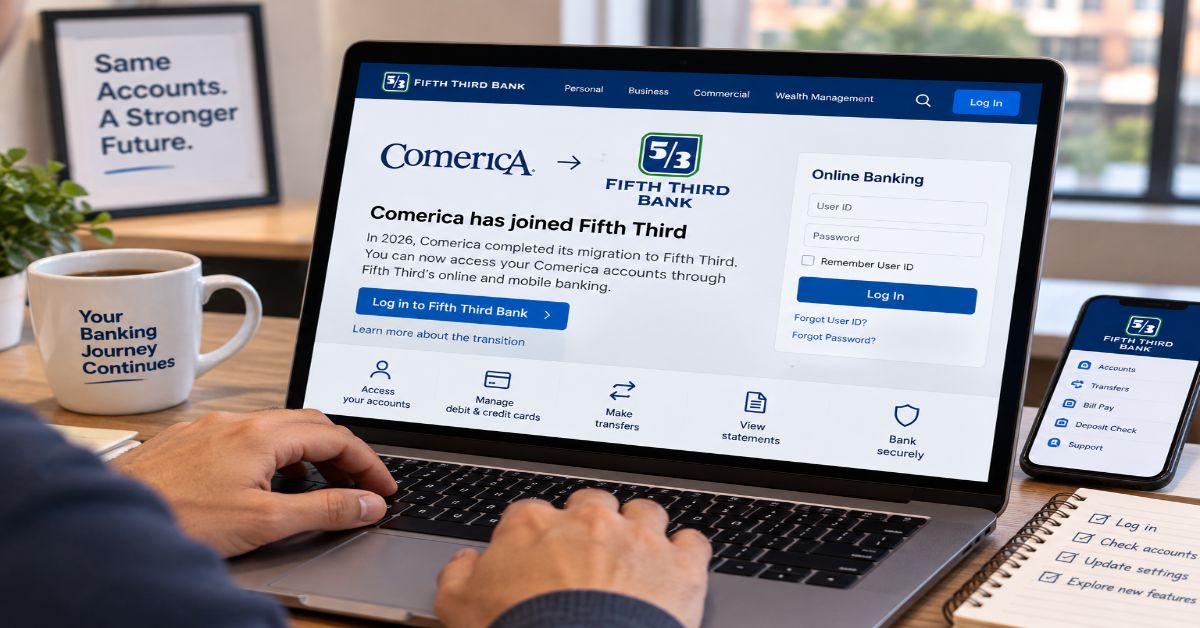
What does “webbanking Comerica web” mean now?
If you search for “webbanking Comerica web” today, you are most likely trying to reach Comerica’s former online banking service or find the correct login page. The important update is that the former Comerica consumer and commercial banking platforms have moved to Fifth Third. On September 8, 2026, Fifth Third completed the technology and brand conversion of approximately 600,000 Comerica customer accounts and 293 banking centers, bringing those customers onto Fifth Third platforms webbanking Comerica web.
That means the old Comerica Web Banking login is no longer the normal destination for deposit and lending customers. For those accounts, the current path is Fifth Third Online & Mobile Banking. Fifth Third says customers should create a new Fifth Third User ID and password rather than reuse their old Comerica credentials webbanking Comerica web.
For a reader searching the phrase specifically, the practical answer is simple: if you need access to a former Comerica checking, savings, CD, or loan account, use Fifth Third’s official enrollment and online-banking system. If you have Comerica investment-management or trust accounts, however, the transition is phased, and those accounts are scheduled to move to Fifth Third on November 2, 2026 webbanking Comerica web.
Quick answer
“WebBanking Comerica web” refers to the Comerica Web Banking service and related login searches. As of October 2026, former Comerica deposit and lending customers should use Fifth Third Online & Mobile Banking, create new credentials at 53.com/enroll, and use their Comerica debit card and PIN—or their account number and Social Security number for one-time identity verification.
Why is Comerica Web Banking no longer the main login?
The change is the result of the Comerica–Fifth Third merger and technology conversion. Fifth Third announced that the companies merged on February 1, 2026, and that the technical conversion was completed over Labor Day weekend, with customer accounts moving to Fifth Third platforms on September 8.
This distinction matters because many older search results, saved bookmarks, help pages, and third-party articles still use the phrase Comerica Web Banking. A search engine can therefore lead a customer to a page that looks familiar even though the banking relationship has already moved to a different platform.
Comerica’s former Web Banking service allowed customers to check balances, review recent transactions, transfer money, communicate electronically with the bank, use Web Bill Pay, make external transfers, and receive electronic bills. Those functions are now part of the successor digital-banking environment rather than a separate Comerica-branded consumer login.
The change also explains why a user may encounter an old Comerica login page while searching. Search visibility does not necessarily mean that a page is the correct place to sign in. For financial accounts, the safest practice is to start from the bank’s current official website instead of relying on an old bookmarked login or an unsolicited email link.
How do former Comerica customers log in to online banking now?
Former Comerica deposit and lending customers should enroll in Fifth Third Online & Mobile Banking. Fifth Third’s current transition guidance says the first step is to create a new Fifth Third User ID and password; the old Comerica User ID and password are not the credentials to use for the new system.
Current enrollment steps
1. Go directly to Fifth Third’s official enrollment page at 53.com/enroll.
2. Have your Comerica debit card and PIN available. Fifth Third says these can be used for one-time identity verification.
3. If you do not have the debit card and PIN, use your account number and Social Security number for the one-time identity-verification process.
4. Create your new secure Fifth Third User ID and password.
5. Follow the guided setup to access your accounts and customize preferences.
6. If you use mobile banking, install the Fifth Third mobile application and sign in with the new credentials.
The critical point is that enrollment is different from simply entering an old Comerica User ID into a new login form. Fifth Third specifically instructs former Comerica customers to establish new credentials.
What information should you have ready?
The exact information you need depends on what you still have available. The transition instructions identify a Comerica debit card and PIN as the preferred verification route. If those are unavailable, the alternative is the account number plus Social Security number for one-time verification.
Do not send this information to someone who contacts you unexpectedly by text, email, or phone. A legitimate banking transition is an attractive opportunity for impersonation scams because customers are already expecting new websites, credentials, and instructions.
What changed between Comerica Web Banking and Fifth Third Online Banking?
The following table summarizes the most important change for ordinary deposit and lending customers.
| Area | Former Comerica Web Banking | Current access after Sept. 8, 2026 |
| Brand | Comerica Web Banking | Fifth Third Online & Mobile Banking |
| Credentials | Comerica User ID and password | New Fifth Third User ID and password |
| Enrollment | Comerica Web Banking enrollment | 53.com/enroll |
| Identity verification | Comerica enrollment process | Comerica debit card + PIN, or account number + SSN |
| Mobile access | Comerica Mobile Banking | Fifth Third Mobile Banking |
| Deposit/lending accounts | Comerica platform | Fifth Third platform |
The table is intentionally limited to the accounts that completed the September 8 conversion. Investment Management and Trust accounts follow a separate transition schedule.
Can you still use a Comerica User ID and password?
For former Comerica deposit and lending customers who are now using Fifth Third Online & Mobile Banking, the answer is no for the new Fifth Third login. Fifth Third explicitly says customers will create new credentials rather than use their Comerica User ID and password.
This is one of the easiest points to misunderstand when searching “webbanking Comerica web.” A person may remember a working Comerica login and assume that the same credentials should work after the migration. The current Fifth Third enrollment instructions make clear that the new system requires a new User ID and password.
If a page asks for a Comerica User ID, pause before entering credentials and verify that you are on the official bank site. Do not assume that a page is safe simply because it contains the Comerica name or logo.
What happened to Comerica statements and transaction history?
Fifth Third says that six months of transaction history, paperless-statement preferences, and 24 months of statements transferred automatically to its system. Customers should also have received a final Comerica statement reflecting activity through September 4, 2026.
This is useful when reconciling accounts after the conversion. If you are comparing a current Fifth Third transaction list with older Comerica records, remember that the conversion date and statement cutoff can make the records appear different from a normal monthly transition.
If a particular historical record is not visible online, keep the final Comerica statement and any other important records you already have. For commercial and specialized accounts, Fifth Third provides separate transition guidance because historical reporting and cash-management data can vary by service.
What if you have Comerica business or commercial banking?
Business customers should not assume that the consumer enrollment instructions apply to them. Comerica Business Connect ended on September 4, 2026, and business customers received access to Fifth Third online banking or Fifth Third Direct beginning September 8, depending on the digital and cash-management services they use.
Fifth Third’s commercial transition information says business customers can access accounts through Fifth Third Direct and that some historical information may not be immediately available in the same form. Customers who need records that did not transfer should contact their relationship team or the appropriate Fifth Third commercial support channel.
For a business, the practical issue is broader than simply logging in. Treasury management, ACH, payment services, reporting, user entitlements, and other specialized services may have separate instructions. The correct access path should therefore be determined from the company’s transition communications and the specific Fifth Third service involved.
| Customer/account type | Current digital access | Key timing |
| Personal checking, savings and most deposit accounts | Fifth Third Online & Mobile Banking | Transition completed Sept. 8, 2026 |
| Personal loans and other lending accounts | Fifth Third Online & Mobile Banking | Transition completed Sept. 8, 2026 |
| Commercial banking | Fifth Third Online Banking or Fifth Third Direct | Access from Sept. 8, 2026 |
| Investment Management & Trust | Comerica Wealth Connect until transition | Moves to Fifth Third Nov. 2, 2026 |
| Institutional investment/trust services | Fifth Third Direct after transition | Transition scheduled Nov. 2, 2026 |
What about Comerica Wealth Connect and investment accounts?
This is the major exception to the simple “Comerica is now Fifth Third” answer. Former Comerica investment-management and trust customers have a phased transition. As of October 2026, those accounts are scheduled to transition on November 2, 2026.
Fifth Third’s wealth guidance says customers should continue using Comerica Wealth Connect for investment, trust, and related wealth-management accounts until that transition. During the period from September 8 through November 2, deposit and lending accounts use Fifth Third, while certain wealth accounts continue through Comerica Wealth Connect.
That means a customer can legitimately have more than one digital-access path during the transition period. The correct login depends on the account type, not simply on whether the customer was formerly a Comerica customer.
Why the November 2 date matters
Fifth Third says investment and trust accounts will move to Fifth Third Private Bank on November 2, 2026. Customers who currently use Comerica Wealth Connect and do not already have Fifth Third Online & Mobile Banking are expected to receive enrollment details as the date approaches.
The bank also says investment history will not transfer into Fifth Third Online & Mobile Banking in the same way as ordinary deposit history. Limited view-only access to Comerica Wealth Connect will be available for a period after the transition so customers can retrieve historical information.
How can you avoid fake Comerica or Fifth Third login pages?
Banking transitions create a predictable phishing opportunity: criminals can imitate a bank’s migration notices and ask customers to “verify” credentials. Fifth Third specifically warns customers that fraudsters may target them during the transition.
Five practical checks before signing in
1. Type the bank’s official web address yourself instead of clicking an unexpected login link.
2. Check the spelling of the domain before entering credentials.
3. Be suspicious of urgent messages demanding immediate verification, payment, or password disclosure.
4. Never give a caller a one-time verification code simply because the caller claims to be from the bank.
5. If you are uncertain, contact the bank through a known phone number or an official website you opened independently.
The strongest habit is simple: separate the message from the login process. Even if an email looks convincing, open your browser independently and navigate to the bank’s official site. This removes one of the easiest ways for a fraudulent link to capture credentials.
What should you do if the old Comerica login no longer works?
First, identify the type of account you are trying to access. For checking, savings, most lending accounts, and other accounts included in the September 8 conversion, use Fifth Third enrollment. For investment and trust accounts that have not yet transitioned, continue using the specified Comerica Wealth Connect route until November 2.
If you are using the correct platform but cannot enroll, avoid repeatedly guessing credentials or entering personal information into multiple sites. Use the official bank’s support resources and explain that you are a former Comerica customer completing the Fifth Third transition.
For business customers, identify whether you need Fifth Third Online Banking, Fifth Third Direct, card-management access, or another specialized service. Business access can depend on the company’s existing cash-management configuration.
| Problem | Likely next step | What to avoid |
| Old Comerica login page appears | Start from Fifth Third’s official site | Entering credentials on an old bookmark |
| Comerica credentials rejected | Create new Fifth Third credentials | Repeatedly guessing the old password |
| No debit card/PIN for enrollment | Use account number + SSN for one-time verification | Sending documents to an unsolicited contact |
| Investment/trust account not visible | Continue Comerica Wealth Connect until Nov. 2 transition | Assuming all accounts moved Sept. 8 |
| Business banking access issue | Check Fifth Third Direct/service-specific instructions | Using consumer enrollment steps for commercial services |
What features should you expect from the new digital banking experience?
The migration is not merely a change of logo. Fifth Third says former Comerica customers gain access to its broader consumer, commercial, payments, and wealth capabilities. For consumer banking, the transition materials highlight Fifth Third’s Online & Mobile Banking platform and mobile app.
Fifth Third also announced features such as Momentum Banking, Early Pay for eligible direct deposits, and Extra Time for eligible overdraft situations. These are features of the successor Fifth Third relationship, not features that should be assumed to be part of the old Comerica Web Banking product.
For customers, the practical lesson is to review the new account and digital-banking interface after enrollment rather than relying on memories of where a feature appeared in Comerica Web Banking. Menu names, alerts, statements, payment workflows, and security controls can change when a bank moves platforms.
Is the phrase “webbanking Comerica web” still useful for searching?
Yes, but mainly as a legacy search phrase. It can help someone who remembers the old Comerica service find information about what happened to it. It is not the best phrase for determining the current login destination because the answer now depends on the account type and transition status.
For current access, more precise searches are likely to be useful: Fifth Third online banking login, Fifth Third enrollment for former Comerica customers, Fifth Third Direct for commercial banking, or Comerica Wealth Connect for investment and trust accounts during the remaining transition period.
This distinction is an important search-intent lesson: a navigational keyword can remain popular after a website or service changes. Searchers may continue using the old brand name because that is what they remember, even though the correct destination has changed.
Key takeaway for former Comerica customers
If you typed “webbanking Comerica web” because you want to log in today, do not spend time trying to revive an old Comerica consumer login. For deposit and lending accounts, the September 8, 2026 conversion moved access to Fifth Third Online & Mobile Banking, where you need new credentials. Fifth Third says to enroll through 53.com/enroll using your Comerica debit card and PIN, or your account number and Social Security number for one-time identity verification.
The one major exception is wealth-related access: Investment Management and Trust accounts are scheduled to transition on November 2, 2026, so customers should continue following the current Comerica Wealth Connect instructions until that date. Business customers should also use the service-specific Fifth Third instructions rather than consumer enrollment steps.
The safest approach throughout the transition is to use official websites, type addresses directly, verify domains, and treat unexpected requests for passwords or verification codes as suspicious. The old search phrase may still bring up historical Comerica pages, but the current banking relationship determines where you should actually sign in.
FAQs
Is Comerica Web Banking still available for regular banking customers?
For former Comerica deposit and lending customers, the regular online-banking platform moved to Fifth Third on September 8, 2026. Those customers should use Fifth Third Online & Mobile Banking and create new credentials.
Where do former Comerica customers enroll for online banking?
Fifth Third directs former Comerica customers to 53.com/enroll. Enrollment uses a Comerica debit card and PIN or, if those are unavailable, the account number and Social Security number for one-time identity verification.
Can I use my old Comerica User ID and password at Fifth Third?
No. Fifth Third’s transition guidance says former Comerica customers create a new Fifth Third User ID and password. The old Comerica credentials are not the new Fifth Third login credentials.
What happened to my Comerica transaction history and statements?
Fifth Third says six months of transaction history, paperless-statement preferences, and 24 months of statements transferred automatically. Customers should also have received a final Comerica statement covering activity through September 4, 2026.
Can I still access Comerica Wealth Connect?
Yes, for investment-management and trust accounts that have not yet transitioned. Fifth Third says those accounts are scheduled to move on November 2, 2026, so customers should continue using Comerica Wealth Connect until the transition.
What should I do if I receive a suspicious Comerica or Fifth Third login message?
Do not use the message’s link or provide credentials, passwords, or verification codes. Open the bank’s official website independently and contact the bank through a known, trusted channel if you need to confirm the message.
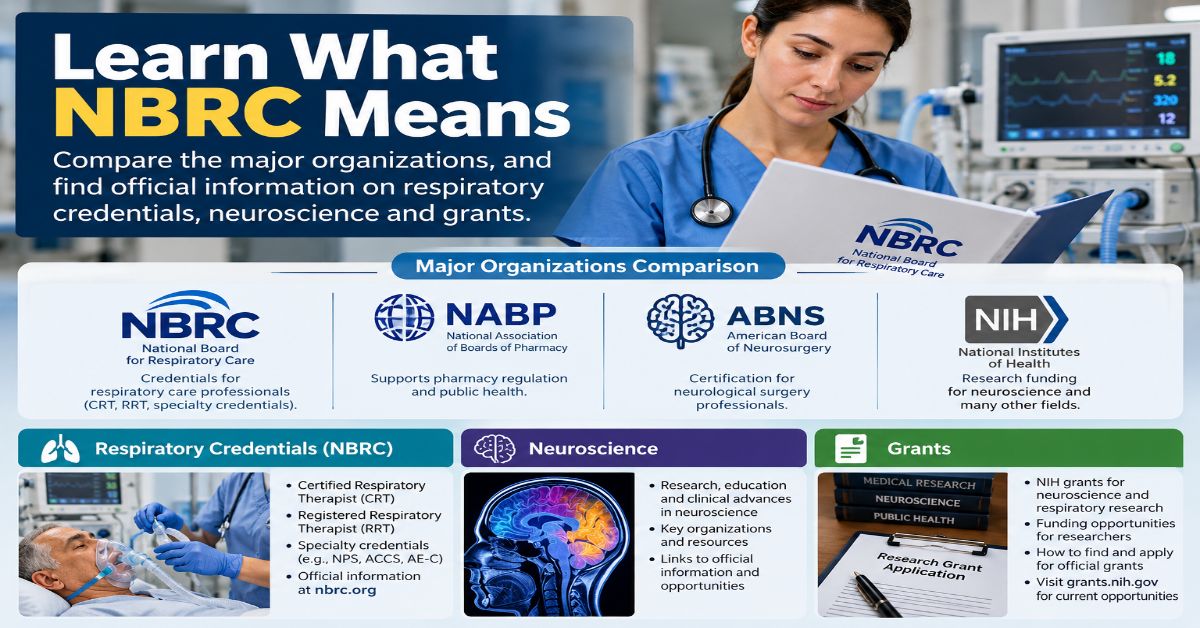
A search for “NBRC” can lead to very different destinations: a respiratory-care credentialing body in the United States, a neuroscience research institute in India, or a regional economic-development commission serving four U.S. states. If you landed on a page that does not match your goal, the problem may not be your search—it may be that the same four letters are used by several organizations.
NBRC does not have one universal meaning. The right interpretation depends on context, including whether you are researching respiratory therapy exams and credentials, brain research and academic programs, or grants for rural communities in the northern United States. This guide distinguishes the major organizations using the acronym, explains what each does, and shows how to verify that you are using the official website before relying on application instructions, deadlines, or eligibility details.
The quickest way to identify the right NBRC is to look at the surrounding terms in your search. Words such as CRT, RRT, respiratory therapist, or credential maintenance point toward the National Board for Respiratory Care. Terms such as neuroscience, Manesar, research, or doctoral study point toward India’s National Brain Research Centre. References to Catalyst grants, rural infrastructure, Maine, New Hampshire, New York, or Vermont point toward the Northern Border Regional Commission. The sections below cover these uses separately so readers can act on the information that fits their needs.
Because acronyms overlap, this article treats each organization as a distinct entity rather than assuming one meaning applies to everyone. Official websites are linked in the relevant sections; program rules and dates should always be checked there because they can change.
What does NBRC stand for?
NBRC is an acronym used by multiple organizations. Three prominent meanings are the National Board for Respiratory Care in the United States, the National Brain Research Centre in India, and the Northern Border Regional Commission in the United States. Their purposes are unrelated, so a reader should confirm the organization before following instructions or citing information.
This comparison helps match common search clues to the correct organization.
| NBRC name | Main purpose | Useful search clues |
| National Board for Respiratory Care | Credentials and examinations for respiratory-care professionals | CRT, RRT, respiratory therapist, exam |
| National Brain Research Centre | Neuroscience research and education in India | brain research, neuroscience, Manesar |
| Northern Border Regional Commission | Economic development funding in designated counties across four U.S. states | grants, rural infrastructure, Catalyst Program |
1. National Board for Respiratory Care: NBRC credentials and exams
The National Board for Respiratory Care (NBRC) is a U.S. not-for-profit credentialing organization focused on respiratory care. Its mission is to promote excellence in the profession by awarding credentials based on demonstrated competence. It develops credentialing examinations and offers credentials for respiratory therapists and pulmonary-function professionals, along with specialty credentials for qualified practitioners.
The organization is relevant to people preparing for respiratory-care examinations, professionals checking credential requirements, educators advising students, and employers seeking to understand professional qualifications. NBRC credentials are not the same thing as a college degree: education provides the foundation, while an examination and the applicable credentialing rules establish whether a candidate has met a defined competency standard.
Which respiratory-care credentials does NBRC offer?
The NBRC website lists several credentials, including Certified Respiratory Therapist (CRT), Registered Respiratory Therapist (RRT), Certified Pulmonary Function Technologist (CPFT), Registered Pulmonary Function Technologist (RPFT), and specialty credentials. Specialty areas include adult critical care, neonatal and pediatric care, sleep disorders, and asthma education. Credential names and eligibility requirements should be confirmed on the official NBRC site before making an exam plan.
The distinction between a general credential and a specialty credential matters. Entry-level credentials establish a professional foundation; specialty credentials are intended to recognize additional knowledge in a defined area. A candidate should not assume that every specialty exam is available immediately after graduation or that the eligibility requirements are identical across credentials.
How should candidates approach an NBRC exam?
Candidates should begin with the official examination page for the exact credential they want. Exam names, eligibility rules, content outlines, fees, scheduling arrangements, and maintenance requirements may differ. The NBRC works with PSI for examination administration, so official candidate instructions should take precedence over informal posts, outdated study guides, or third-party summaries.
Identify the exact credential and read its current eligibility requirements.
Review the official content outline and any candidate handbook linked from the credential page.
Confirm how the examination is scheduled, what identification is required, and which policies apply on test day.
Use reputable study materials that match the current exam outline, and build practice around the skills and concepts named there.
After passing, review the credential-maintenance rules and keep personal contact details current.
A practical example: someone searching “NBRC RRT exam” is probably not looking for a brain-research institute or a grant commission. They need the respiratory-care credential pathway, the current exam requirements, and the relevant candidate resources.
Where can readers verify NBRC respiratory-care information?
Start with the official website: https://www.nbrc.org/. Its candidate resources, credential pages, and contact information are the best starting points for current rules. For questions that are not answered online, the organization publishes its executive-office contact details on its official contact page: https://www.nbrc.org/contact/. Avoid sharing personal information or payment details through unofficial accounts that merely use the NBRC name.
2. National Brain Research Centre: NBRC in India
The National Brain Research Centre (NBRC) is an Indian institute dedicated to neuroscience research and education. It is located in Manesar, Haryana, and is an autonomous institute supported by India’s Department of Biotechnology; it also has deemed-university status. Its work brings together researchers from fields such as biology, computation, mathematics, physics, and engineering to study the brain and nervous system.
This NBRC is relevant to prospective research students, scientists, academic collaborators, and readers seeking reliable information about neuroscience projects. It is not the U.S. respiratory-care credentialing body and does not administer the NBRC respiratory-therapy examinations.
What does the National Brain Research Centre study?
Neuroscience investigates the structure and function of the nervous system, including how people sense, learn, remember, move, and respond to the world. NBRC describes research across cellular and molecular neuroscience, systems neuroscience, cognitive neuroscience, computational neuroscience, and translational neuroscience. These areas range from studying mechanisms inside individual cells to investigating cognition and developing approaches that may eventually improve understanding of neurological disorders.
The institute’s research themes include brain function in health and disease, sensory processes, learning and memory, and disorders affecting the nervous system. Such research is multidisciplinary: a project may combine biological experiments with mathematical modelling, computational analysis, imaging, or clinical collaboration. That breadth is one reason the institute may interest students from different academic backgrounds.
How can a prospective student or researcher use NBRC’s website?
A prospective applicant should first identify whether the goal is a degree, a research position, a short course, or collaboration. The entry route and required qualifications can differ. Check the institute’s current admissions announcements, faculty and research pages, and official notices rather than relying on a cached search snippet or an old social-media post.
For study: verify the current programme, eligibility, application dates, selection process, and required documents.
For research: review faculty interests and research divisions, then follow the institute’s official process for contacting a group or applying for a position.
For events and training: check the current notices for dates, registration rules, and whether the event is open to external participants.
Official starting points include the institute’s profile on the Indian government’s BRIC website at https://www.bric.nic.in/institutes/nbrc/ and the Government of India’s India Science, Technology & Innovation portal at https://www.indiascienceandtechnology.gov.in/organisationsdbt/national-brain-research-centre-nbrc. These sources identify the institution and describe its research and educational role.
3. Northern Border Regional Commission: NBRC grants and economic development
The Northern Border Regional Commission is a federal-state partnership supporting economic and community development in designated counties in Maine, New Hampshire, New York, and Vermont. Created by Congress in 2008, the commission directs resources toward regional strategies and projects intended to strengthen economic opportunity and community vitality. It is the relevant NBRC for local governments, eligible organizations, community-development groups, and other applicants exploring regional funding.
Unlike the National Board for Respiratory Care, this NBRC is not a credentialing organization. Unlike the National Brain Research Centre, it is not a neuroscience institute. The strongest clues are references to grant applications, eligible counties, infrastructure, workforce development, rural economies, or the commission’s named funding programmes.
What kinds of projects may NBRC support?
The commission’s programmes are designed to address economic and community-development needs in its service area. Programme priorities and eligible costs vary, but applicants may encounter themes such as infrastructure, workforce capacity, business and industry development, and projects that strengthen regional economic resilience. A project’s general usefulness is not enough to establish eligibility: the applicant type, location, programme objectives, match requirements, and application stage all matter.
The NBRC has described programmes including the Catalyst Program, Forest Economy Program, and Timber for Transit Program. The active portfolio, application windows, funding availability, and rules can change from year to year. Therefore, an article or government page from a previous funding cycle should be treated as background rather than proof that a programme is currently open.
How does an organization start an NBRC grant application?
The commission’s applicant resources explain that pre-applications are required for its grant programmes. A pre-application is not the same as a full application: an organization must follow the commission’s process and receive an invitation to apply before submitting a full application through its Grants Management System, where applicable.
Confirm that the proposed project and applicant are located within the programme’s eligible area and fit the current programme rules.
Read the current funding notice, applicant guidance, and programme-specific requirements from the official NBRC website.
Register or update the organization’s account and authorized contacts in the Grants Management System as directed.
Prepare the required pre-application and supporting information, paying attention to project scope, budget, outcomes, partnerships, and any match requirements.
Submit through the designated system and retain confirmation records. Do not assume that downloading a blank form or emailing it separately counts as submission.
The commission’s applicant-resources page is the key starting point: https://www.nbrc.gov/applicant-resources. Its official overview is at https://www.nbrc.gov/about-nbrc. Applicants should use these pages for the current process and deadlines, not rely on a third-party list that may describe a previous year’s programme.
How can you tell which NBRC you need?
Use the context around the acronym rather than the letters alone. This table maps common searches to the most likely organization and the next useful action.
| If your search mentions… | Likely NBRC | Best next step |
| CRT, RRT, respiratory therapy, exam eligibility | National Board for Respiratory Care | Open the credential or candidate page at nbrc.org |
| Neuroscience, brain research, Manesar, PhD | National Brain Research Centre | Check official institute admissions and research notices |
| Catalyst, grant, eligible counties, rural development | Northern Border Regional Commission | Read current programme guidance and applicant resources |
| Only “NBRC,” with no other context | Ambiguous | Add a location, profession, programme, or goal to the search |
Common mistakes to avoid when researching NBRC
Assuming the acronym identifies one organization
The most common mistake is treating the first search result as the only possible meaning. Check the full organization name, country, official domain, and purpose before acting. A credentialing rule from the U.S. respiratory-care organization will not answer a question about Indian neuroscience admissions or regional grants.
Relying on old deadlines or third-party summaries
Exam rules, academic admissions, and grant cycles are all time-sensitive. A page may remain visible after its deadline has passed. Look for a current date, programme year, official notice, or candidate handbook, and confirm important requirements directly with the organization.
Confusing a credential, an academic qualification, and a grant
These are different kinds of institutional activity. A professional credential records that a person has met a competency standard; an academic programme provides education or research training; a grant programme allocates funding under defined eligibility and selection rules. The shared acronym does not make their processes interchangeable.
Treating search snippets as complete instructions
Search-result summaries can omit exceptions, eligibility conditions, or later updates. Use snippets to identify the likely page, then read the official source itself. Before paying a fee, submitting sensitive documents, or committing project resources, confirm that the destination is an official channel.
A quick verification checklist
Before using any NBRC information, check these five details:
Full name: Does the page spell out the organization’s complete name?
Location: Does the country, state, or city match your intended organization?
Purpose: Is the page about credentials, neuroscience, or economic-development funding?
Date: Are the deadline, exam rules, or programme requirements current?
Official source: Is the information published by the organization or a relevant government agency?
This checklist is simple, but it prevents a costly category error—such as preparing for the wrong examination, contacting an unrelated institute, or using a grant form from a past funding cycle.
Conclusion: Start with the full name, not just NBRC
NBRC is a useful search term only when paired with the right context. The National Board for Respiratory Care supports professional credentialing in respiratory care; India’s National Brain Research Centre advances neuroscience research and education; and the Northern Border Regional Commission supports economic development in designated communities across four U.S. states. Each serves a different audience and has its own official procedures.
For the fastest route to an accurate answer, add the goal or location to the acronym, open the official site, and verify current requirements before acting. That small step makes the search more precise and helps ensure that the information you use actually belongs to the organization you intended.
Frequently asked questions about NBRC
Is NBRC a medical certification organization?
It can refer to one: the National Board for Respiratory Care in the United States awards respiratory-care credentials. However, NBRC also refers to unrelated organizations, including a neuroscience institute in India and a regional development commission.
What is the official website for the National Board for Respiratory Care?
The official website is https://www.nbrc.org/. Use its credential, examination, candidate-resource, and contact pages to verify current information.
Where is the National Brain Research Centre located?
The National Brain Research Centre is located in Manesar, Haryana, India. Government institute profiles describe it as a centre for neuroscience research and education.
Can anyone apply for an NBRC grant?
No. For the Northern Border Regional Commission, eligibility depends on the current programme rules, applicant type, project, and designated service area. Review the official applicant resources before beginning an application.
Does NBRC mean the same thing in India and the United States?
No. The National Brain Research Centre is in India, while the National Board for Respiratory Care and Northern Border Regional Commission are U.S.-based organizations with different responsibilities.
How do I make an NBRC search more specific?
Add a clear clue such as “RRT exam,” “neuroscience admissions,” or “Catalyst grant.” Including the location or the full organization name also helps distinguish official information from unrelated results.

A jewelry purchase can begin with a simple goal—find an engagement ring, replace a watch, repair a family heirloom—and quickly become a series of decisions about quality, fit, service, and value. For shoppers searching “new york jewelers Chicago,” the name refers to New York Jewelers, a long-established jewelry and watch retailer in downtown Chicago, not a store in New York City. The business lists its showroom at 11 North Wabash Avenue and says it has operated locally since 1890. [1][2]
The most useful way to evaluate the store is to match its services to the job you need done. New York Jewelers promotes engagement and wedding jewelry, loose diamonds, custom design and in-house manufacturing, new and pre-owned watches, jewelry and watch servicing, appraisals, insurance replacement assistance, and collateral-based luxury loans. Its broad offering may suit someone who wants to compare several categories in one visit, but the right choice still depends on the specific item, written terms, budget, and service timeline.
In brief: New York Jewelers is a downtown Chicago destination for fine jewelry, bridal pieces, watches, custom work, and selected after-sale services. Before making a high-value purchase or leaving an heirloom for repair, confirm the current inventory, exact service scope, price, completion date, return or warranty terms, and any documentation you will receive. This guide explains how to plan a visit, compare options, and ask practical questions so you can make a decision based on details rather than presentation alone.
What Is New York Jewelers in Chicago?
New York Jewelers is an independently owned jewelry retailer in Chicago’s Loop, near the city’s downtown Jeweler’s Row corridor. The company’s published history says it was established in 1890 and describes more than 12,000 square feet of combined showroom space, along with an in-house manufacturing and custom-design center. Those are business-reported details, so shoppers should treat them as the retailer’s own description rather than an independent ranking. [1]
Its showroom is at 11 North Wabash Avenue, Chicago, IL 60602. The official website lists the phone number as (312) 855-4999 and encourages customers to schedule appointments for shopping consultations. Because hours, staffing, inventory, and service availability can change, check the current official website or call before traveling. [1][3]
The phrase “New York Jewelers Chicago” can be confusing because the name includes New York. The business is physically located in Chicago. If you are searching for a New York City jeweler, confirm the address before booking an appointment or ordering online.
Which Jewelry and Watch Services Are Available?
The retailer’s website groups its offerings across jewelry, bridal purchases, watches, and support services. The list below summarizes published categories; it does not guarantee that a particular size, stone, model, repair part, or appointment slot is available on the day you visit. [1][2][3]
| Category | What to explore | Questions to ask |
| Engagement and wedding jewelry | Engagement rings, wedding bands, diamond settings, preset styles, loose diamonds | Can I compare the stone and setting separately? What is included in the final price? |
| Fine jewelry | Rings, earrings, necklaces, bracelets, men’s jewelry and gemstone pieces | What are the metal purity, stone details, and care requirements? |
| Custom design | A personalized piece developed with design and manufacturing support | What are the design, approval, deposit, revision, and final-delivery stages? |
| New watches | Watches from brands the retailer lists as authorized offerings | Is this model in stock, and what manufacturer warranty applies? |
| Pre-owned watches | Previously owned timepieces, including selected luxury brands | What is the condition, service history, included documentation, and return policy? |
| Service and documentation | Jewelry or watch service, appraisals, insurance replacement assistance, and luxury loans | Who performs the work, what is the fee, and what written record will I receive? |
A practical distinction matters: buying a product, commissioning a custom piece, requesting a repair, and borrowing against an item are different transactions. Each should have its own written scope and terms. Do not assume that a policy for a standard online purchase also applies to custom work, altered items, pre-owned watches, or loan agreements.
Is New York Jewelers a Good Place to Shop for an Engagement Ring?
It may be a useful option for shoppers who want to compare loose diamonds with different settings or discuss a custom design. The retailer says it carries hundreds of certified loose diamonds and engagement styles, and that it has more than 2,000 diamond settings available. These are figures published by the business and should be confirmed for current selection and availability. [2]
A productive engagement-ring appointment starts with your priorities, not with a particular display case. Decide what matters most—shape, overall appearance, metal, durability, budget, or the ability to resize the ring later. If you are buying together, discuss whether the wearer prefers a low-profile setting, a prominent center stone, a vintage-inspired look, or a simpler design that fits daily routines.
How should you compare diamonds?
For a diamond, ask for the grading report and compare the familiar 4Cs: cut, color, clarity, and carat weight. A report from a recognized independent gemological laboratory can help you verify the stone’s stated characteristics. The report is not the same as a store warranty, and it does not by itself determine whether a particular diamond is worth the asking price.
Cut and appearance: Ask to view stones in comparable lighting and from more than one angle. A higher carat weight does not automatically mean a diamond will look brighter.
Color and clarity: Compare visible differences with your own eyes, while checking the grading documentation. Do not pay for a grade you cannot explain or do not value.
Setting and wear: Consider prong security, ring height, comfort, and how the design will hold up to daily use.
Total cost: Request an itemized quote that separates the center stone, setting, labor, tax, and any additional services.
If a custom ring is being considered, bring reference photos and explain which elements you like. Ask when you will approve the design, whether a rendering or wax model is included, how many revisions are covered, and what happens if the finished piece differs from the approved specifications. Record stone details, metal type, ring size, delivery date, and any agreed adjustments in writing.
How Can You Compare New and Pre-Owned Watches?
New York Jewelers lists both new watches and pre-owned timepieces. Its published brand information includes authorized new-watch brands and pre-owned examples from makers such as Cartier, Omega, Patek Philippe, and Rolex. Availability varies, so a named brand on a website should not be treated as confirmation that a specific reference is currently in stock. [1][2]
| Check | New watch | Pre-owned watch |
| Condition | Confirm the exact model and whether it is new and unworn | Ask about wear, replaced parts, polishing, and prior repairs |
| Documentation | Confirm box, papers, serial/reference details, and warranty card where applicable | Ask which original documents are included and whether service records exist |
| Warranty | Check the manufacturer’s warranty duration and exclusions | Read the seller’s written warranty and its limits |
| Price comparison | Compare the same model and reference across authorized sellers | Compare condition, age, accessories, service history, and recent comparable listings |
| Resale or trade credit | Ask how future trade credit is calculated | Ask whether any quoted value depends on buying another item |
Before paying, inspect the watch’s reference and serial details where appropriate, check that the paperwork matches the item, and request a written description of condition. For a mechanical watch, ask whether it has been serviced, whether water resistance has been tested, and whether any guarantee covers the movement. A water-resistance rating is not a promise that an older watch remains water-resistant today.
If you plan to trade a watch toward another purchase, ask for two figures: the value offered for your current watch and the price of the new or pre-owned watch before the trade credit. That separation makes it easier to compare offers with another dealer and understand whether the trade is genuinely competitive.
What Should You Know About Repairs, Appraisals, and Insurance?
A retailer with an on-site service center can be convenient for routine work and for discussing a complicated repair in person. New York Jewelers advertises a service center and lists services such as jewelry repairs, appraisals, and insurance replacement support. The precise work accepted, turnaround time, and fee should be confirmed directly before you leave an item. [1][3]
Before leaving jewelry or a watch for repair
Ask for a written intake record that describes the item, visible condition, stones, serial or identifying marks, and accessories left with it.
Request an estimate and ask whether the shop will contact you before performing work that increases the price.
Confirm the expected completion date and how you will be notified if parts or specialist work cause a delay.
Ask what the repair warranty covers, how long it lasts, and what situations are excluded.
Photograph the item and retain the receipt or service ticket until you have inspected the completed work.
For an appraisal, clarify its intended purpose. An insurance replacement appraisal, a resale estimate, and a value used for estate planning are not interchangeable. Tell the appraiser how the document will be used and ask what methodology, item description, photographs, and qualifications will appear in the report. Insurers may have their own documentation requirements, so check with your insurer before commissioning the appraisal.
Insurance replacement assistance is also different from an insurance company’s decision about a claim. Ask who communicates with the insurer, what information is needed, whether you can choose the replacement, and whether any fees or limitations apply.
How Do Luxury Loans Against Jewelry or Watches Work?
New York Jewelers promotes a Luxury Loans service involving cash loans secured by fine jewelry or watches. A collateral loan is not the same as selling an item: the customer receives funds under an agreement and the item is held as security. The contract, not the marketing description, determines repayment obligations and what happens if the loan is not repaid. [1]
Before accepting a loan, ask for the complete written agreement and make sure you understand:
The principal amount you will receive and every fee or charge.
The interest rate, how it is calculated, and the total amount due by the repayment date.
The due date, renewal or extension rules, and any grace period.
How the item is described, valued, stored, insured, and returned after repayment.
The exact process and consequences if you miss a payment or cannot repay.
If your goal is to sell an item rather than borrow against it, request a separate outright purchase offer. For either transaction, comparing more than one written offer is a sensible way to understand the market. Do not hand over a valuable item until you have read the terms and received documentation identifying it.
What Is the Best Way to Plan a Visit to New York Jewelers Chicago?
The store is in Chicago’s Loop at 11 North Wabash Avenue. Its official site recommends appointments for shopping consultations, and its appointment page says valet parking is available in front of the building. Confirm the latest details before setting out, especially if you are traveling from outside downtown or need a specific specialist. [1][3]
| Before the visit | Why it helps | What to bring or prepare |
| Set a budget range | Keeps comparisons focused and helps avoid mismatched options | A comfortable target and a firm maximum |
| List your priorities | Makes the consultation more efficient | Preferred metal, stone shape, watch model, or repair goal |
| Gather existing records | Helps establish ownership, specifications, or prior service | Receipts, grading reports, warranty cards, appraisals, service records |
| Book the right appointment | Allows staff to prepare for a specific need | Explain whether you want bridal advice, a watch consultation, an appraisal, or a loan discussion |
| Confirm terms in advance | Reduces surprises at checkout or collection | Ask about fees, deposits, lead times, returns, and required identification |
For a focused engagement-ring appointment, ask whether the consultant can prepare a range of stones and settings within your budget. For a watch visit, provide the brand and reference number if you have one. For a repair, describe the problem and ask whether the item needs to be left for inspection. A little preparation makes it easier to use the appointment for meaningful comparisons rather than basic fact-finding.
How Should You Evaluate Price, Policies, and Customer Experience?
A luxury showroom can offer selection and specialist support, but those benefits do not remove the need to compare terms. Look beyond the display price and ask for the full cost of ownership: taxes, sizing, maintenance, warranty coverage, insurance documentation, and potential return restrictions.
Online policies can differ by product type. The retailer’s website publishes purchase and return terms, but special orders, custom-made pieces, clearance items, and altered products may be treated differently from standard merchandise. Read the policy that applies to the exact item before paying, and save a copy of the terms presented at checkout. [4]
Customer reviews can help identify questions to ask, but they are not a substitute for a written quote or contract. Review patterns may reflect different departments and transaction types: buying a new ring, selling a pre-owned watch, and arranging a repair are distinct experiences. When reading reviews, look for specific descriptions of communication, delivery, service follow-up, and how concerns were resolved rather than relying only on a star average.
For a high-value purchase, use this simple decision test:
Can the seller document exactly what is being sold or serviced?
Are the price, taxes, deposits, delivery dates, and return rules clear in writing?
Can you explain the warranty and what it excludes?
Have you compared the offer with at least one credible alternative?
Do you feel you have enough time and information to decide without pressure?
If any answer is no, pause and request clarification. A careful jeweler should be able to explain the item and its terms in language you understand.
Conclusion: Is New York Jewelers Chicago Worth Considering?
New York Jewelers is a long-established downtown Chicago retailer with offerings that span bridal and fine jewelry, custom design, new and pre-owned watches, service work, appraisals, and collateral loans. Its range makes it worth considering when you want to explore more than one category or discuss a personalized piece in person. The strongest reason to visit, however, is a clear match between your need and the store’s current inventory or services.
Go prepared with a budget, specific questions, and any relevant paperwork. Confirm availability and appointment details before traveling, and get the item description, price, timeline, warranty, and transaction terms in writing. Those steps make it easier to judge whether the product and service are right for you—at New York Jewelers or anywhere else.
Frequently Asked Questions
Where is New York Jewelers located in Chicago?
The official website lists the showroom at 11 North Wabash Avenue, Chicago, IL 60602. Call (312) 855-4999 or check the official website before visiting to confirm current hours and appointment details. [1]
Does New York Jewelers offer custom engagement rings?
The retailer advertises custom design and in-house manufacturing support. Ask about design approvals, revisions, deposits, delivery timing, and the final written specifications before commissioning a piece. [2]
Can I shop for pre-owned luxury watches there?
Yes, the retailer lists a pre-owned watch collection. A specific brand or model may not always be available, so confirm stock and request details about condition, service history, included paperwork, warranty, and return terms. [1][2]
Can I get jewelry appraised for insurance?
The retailer advertises appraisal services. Before booking, tell the appraiser that the report is for insurance and ask what documentation is included. Confirm any insurer-specific requirements directly with your insurance provider. [1]
Should I make an appointment before visiting?
The store encourages appointments for jewelry and watch consultations. Booking ahead is particularly useful when you want to compare diamonds, discuss a custom design, or meet with a specialist. Check the current appointment calendar before traveling. [3]
What should I check before selling or borrowing against a watch?
Ask for a written valuation and a clear explanation of the transaction. For a sale, compare outright purchase offers. For a loan, review the amount advanced, fees, interest, repayment deadline, renewal terms, storage arrangements, and consequences of nonpayment before signing.
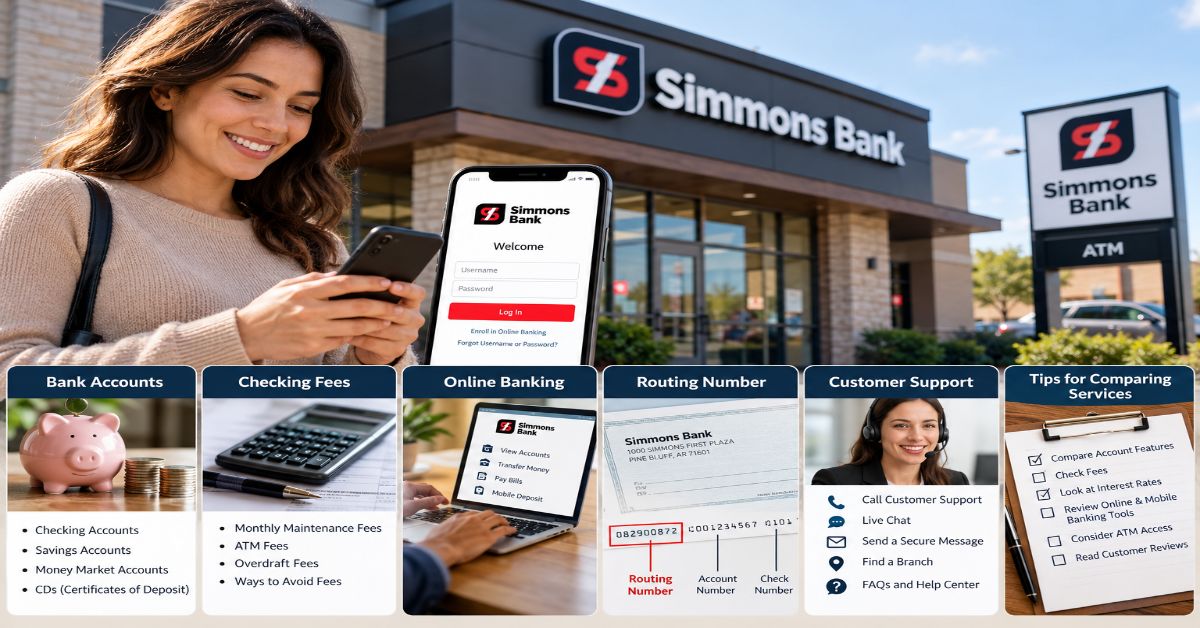
A banking decision often starts with a small, practical question: Can you avoid a monthly fee, deposit a check from your phone, or reach a real person when a card goes missing? Simmons Bank is a U.S. regional bank offering personal and business banking, lending, credit cards, digital banking, and wealth-related services. This guide explains what the bank offers, how its checking options differ, what to know before opening an account, and where to find official support information.
The short answer: Simmons Bank serves customers through branches in Arkansas, Kansas, Missouri, Oklahoma, Tennessee, and Texas, as well as online and mobile banking. Its consumer products include checking and savings accounts, certificates of deposit, money market accounts, credit cards, mortgages, consumer loans, and digital payment tools. Account availability, fees, eligibility, and promotional terms vary by product, so review the current disclosures before applying.
This article is intended for people comparing banks, existing customers who need practical account or login information, and readers checking whether Simmons Bank fits their everyday needs. It uses the bank’s published product and support pages for account details and contact information. It is not a recommendation to open an account: the best choice depends on how you receive income, how often you use ATMs, whether you need branches, and how much you can maintain in the account. Because fees and offers can change, confirm any detail that affects your decision directly with Simmons Bank before taking action.
What is Simmons Bank?
Simmons Bank is a regional financial institution headquartered in Pine Bluff, Arkansas, and a wholly owned subsidiary of Simmons First National Corporation. The bank says it has served customers since 1903 and operates 220 branches across Arkansas, Kansas, Missouri, Oklahoma, Tennessee, and Texas. Its offerings cover everyday deposits, lending, digital services, and business banking. These facts make it especially relevant to people who live or work in its branch footprint, although online tools allow customers to manage eligible accounts remotely.
A branch footprint matters for more than convenience. Customers who regularly deposit cash, need a cashier’s check, or prefer face-to-face help may value a nearby location. Customers who rarely visit branches may focus more on mobile deposit, bill pay, transfer options, ATM access, and account fees. Simmons Bank’s online and mobile services support common tasks such as viewing balances and transactions, transferring money, paying bills, sending money with Zelle, setting card controls, and depositing checks.
Which Simmons Bank accounts are available?
Simmons Bank offers multiple deposit products, but the right account depends on the job you need the money to do. Checking is designed for frequent spending and bill payments; savings and money market accounts are generally intended for money you want to set aside; and certificates of deposit (CDs) typically exchange easier access for a defined term and rate. Read the applicable account agreement and fee schedule rather than assuming that products with similar names work the same way.
The bank’s published checking lineup includes Smart Checking, Signature Checking, Signature Plus Checking, and Private Banking Checking. Names and terms should always be confirmed on the live product page because financial institutions can revise product ranges or eligibility rules. The comparison below summarizes published features, not a guarantee that every applicant will qualify.
How do Simmons Bank checking accounts compare?
The table provides a quick comparison of selected checking accounts and their advertised monthly service charges. “$X or $0” means the stated charge may be waived when the account holder meets the bank’s listed conditions; it does not mean every account is automatically free.
Simmons Bank checking accounts at a glance
Published monthly service charges and selected features differ by account. Confirm current details and waiver conditions on the bank’s official checking page.
| Account | Published monthly charge | Selected features | Best fit to consider |
| Smart Checking | $10 or $0 | No overdraft fee for covered situations; no checks; Early Payday; Round-Up | Customers who want a simple account and can meet a waiver condition |
| Signature Checking | $6 or $0 | Early Payday; credit-score monitoring; Round-Up; check-order discount | Everyday use with several possible fee-waiver routes |
| Signature Plus Checking | $12 or $0 | Earns interest; check benefits; Signature features | Customers who may meet higher deposit or balance thresholds |
| Private Banking Checking | $25 or $0 | Interest and additional private-banking services | Customers who qualify for a broader private-banking relationship |
How can you avoid monthly checking fees?
Simmons Bank lists ways to waive the monthly service charge on several checking products. For Smart Checking, the bank says the $10 monthly charge can be waived by having one direct deposit or one debit-card transaction. Signature Checking lists several potential waiver routes, including qualifying direct deposits, balance requirements, age-based eligibility, or debit-card activity. Signature Plus Checking lists higher deposit or balance thresholds and a military-related waiver. Requirements differ by account, and the bank may revise them.
Before choosing an account, estimate your normal monthly activity rather than relying on a waiver you may struggle to meet. If your income arrives by direct deposit, a deposit-based waiver may be simple. If your balance fluctuates, a minimum-balance requirement may be less dependable. If you use a debit card frequently, a transaction-based option may be practical—but confirm exactly which transactions count.
Paper statements can also add a recurring cost. Simmons Bank’s published checking information lists a paper-statement fee and says enrolling in eStatements can avoid it. Review the disclosure for the specific account you select, because the amount and conditions may differ across products.
What can you do with Simmons Bank online and mobile banking?
Simmons Bank Online & Mobile is designed to let customers manage eligible deposit accounts without visiting a branch. Published features include balance and transaction monitoring, bill payment, transfers between accounts, Zelle payments, credit-score tools, card controls, mobile check deposit, and secure messages. The bank says online and mobile banking use the same login credentials.
A practical first-time setup is straightforward:
Start from the bank’s official website or install the official Simmons Bank app from your device’s trusted app store.
Enroll using the bank’s official enrollment process and the information it requests.
Create a strong, unique password and enable two-factor authentication where available.
Turn on account alerts that help you notice unexpected transactions or low balances.
Review your contact information so the bank can reach you about account security.
Test a low-risk task, such as viewing recent transactions, before relying on the app for an urgent payment.
For check deposits, follow the app’s instructions carefully: photograph the check clearly, enter the correct amount, and retain the check until the bank’s instructions say it is safe to dispose of it. Mobile deposit requires a data connection, and availability can depend on account eligibility, app version, and other restrictions. A submitted deposit is not always the same as immediately available funds, so check the app for any hold or availability notice.
If you cannot sign in, use the official “Forgot?” password-reset option rather than a link in an unsolicited text or email. Simmons Bank lists 1-866-246-2400 for general banking and online-banking support. Never share a one-time security code with someone who contacts you unexpectedly, even if the caller claims to be from the bank.
Can you open a Simmons Bank account online?
Simmons Bank allows eligible customers to open selected accounts online. Its published online-opening information lists products such as Smart Checking, Signature Checking, Signature Plus Checking, Simply Savings, Elevate Money Market, and certificates of deposit, though availability depends on product and eligibility. The bank’s current pages state that online opening for certain accounts is limited to residents of Arkansas, Kansas, Missouri, Oklahoma, Tennessee, and Texas, and that applicants must be at least 18 for the stated online process.
The bank says applicants opening checking or savings online need a valid state-issued ID, a Social Security number, and a computer or mobile device with a camera. A CD application may require additional information and a qualifying opening deposit. Requirements vary by product, and online applications may not support every ownership arrangement. For example, joint ownership or adding beneficiaries may require a branch visit for some accounts.
A sensible application checklist is to confirm that your state is eligible, compare the current fee schedule, gather identification details, and decide how you will fund the account. Read all disclosures before submitting the application. If the online process fails or the identity scan does not work, contact support through the number listed on the official website instead of sending identity documents to an address supplied by an unverified message.
Savings, money market accounts, and CDs
Checking accounts are usually optimized for payments, while savings products are intended to help keep money separate from everyday spending. Simmons Bank lists savings, money market, and CD options among its deposit products. The best fit depends on access needs, the amount you can deposit, the interest rate offered, and any minimum-balance or withdrawal rules. Do not assume a product’s rate or minimum from an older advertisement; verify the current terms on the bank’s official pages.
A money market account may combine interest with some transaction access, but rules can differ from a standard savings account. A CD typically has a set term, and withdrawing funds early may trigger a penalty under the agreement. When comparing products, calculate the likely return after fees and consider whether you might need the money before the term ends. A slightly higher rate may not be worth it if the account’s restrictions do not match your plans.
Deposit insurance is another important consideration. Simmons Bank identifies itself as a Member FDIC institution on its official materials. FDIC insurance generally protects eligible deposits at an insured bank up to applicable limits and ownership-category rules; it does not insure investments such as stocks or mutual funds. For coverage questions, consult the FDIC’s official resources and confirm the account’s legal institution and ownership category.
Loans, credit cards, and business services
Beyond deposits, Simmons Bank advertises consumer lending, mortgages, home-equity lines of credit, credit cards, and business financial services. Business customers may find checking and savings, lending, treasury management, and digital banking tools. The details that matter most—interest rates, fees, repayment terms, credit requirements, collateral, and closing costs—depend on the product and applicant. A headline offer should never replace reading the actual agreement.
For a loan, compare the annual percentage rate (APR), not just the monthly payment. A lower payment can reflect a longer repayment period and a higher total cost. For a home-equity line of credit, understand whether the rate can change, how payments are calculated, and what happens when the draw period ends. For credit cards, check the purchase APR, balance-transfer terms, late fees, and rewards exclusions. Business customers should also ask how account fees scale with transaction volume and whether treasury services have separate pricing.
Simmons Bank’s website provides pathways to contact mortgage, consumer-loan, investment, insurance, and private-banking advisors. If you are comparing offers from multiple institutions, request written terms for the same borrowing amount and duration so the comparison is meaningful.
Simmons Bank routing number and customer service
Simmons Bank publishes routing number 082900432. A routing number is used for certain U.S. payment transactions, but customers should confirm the correct number and instructions for their specific transaction—especially wire transfers, which may have separate instructions. Do not rely on a number copied from an old form or an unverified website when sending money.
The bank’s contact page lists 1-866-246-2400 for general banking questions and online banking, 1-877-245-1234 for 24-hour telephone banking, and 1-800-272-2102 for consumer credit-card service. It also lists separate numbers for business credit cards and lost or stolen cards. Contact details can change, so use the official contact page as the final source before calling.
If your debit card is lost, contact the bank immediately using the number published on its official website or in the verified app. If you suspect fraud, secure your login, review recent activity, report unauthorized transactions promptly, and follow the bank’s instructions. Keep records of the time you reported the issue and any case or confirmation number provided by the bank.
Is Simmons Bank right for you?
Simmons Bank may be worth considering if you live in its regional footprint, want a branch as well as mobile access, or prefer to keep checking, savings, borrowing, and other financial services with one institution. Its online features may also appeal to customers who manage most routine banking from a phone. Those advantages should be weighed against the account’s fee rules, your access to branches and ATMs, and the rates available for savings or borrowing.
Use this checklist before deciding:
Branch access: Is there a convenient location for cash deposits or in-person help?
Fees: Can you reliably meet the waiver requirements, and are paper statements or other services extra?
Digital tools: Does the app support the tasks you actually use, including mobile deposit and alerts?
ATM access: Confirm the network and any out-of-network charges that may apply.
Savings return: Compare current APYs and minimums across competing institutions.
Borrowing costs: Compare APR, total repayment, and fees—not just advertised monthly payments.
Eligibility: Confirm that your location, age, identification, and account ownership needs fit the product’s rules.
A useful way to make the choice is to review one month of your own banking habits. Count how often you use cash, how many payments you make, whether direct deposit is available, and the balance you typically keep. Then compare those facts with the account’s actual terms. This turns “Which bank is best?” into a more answerable question: “Which account costs the least and supports the services I use?”
Conclusion: the key facts about Simmons Bank
Simmons Bank is a long-established regional bank with branches in six states and online tools for routine account management. It offers several checking options, savings and money market products, CDs, lending, credit cards, and business services. The most important decision points are the monthly fee and waiver rules, your eligibility for online account opening, digital features, and the current terms for any deposit or credit product.
For accurate, up-to-date information, start with the bank’s official website, review the relevant disclosures, and contact customer support if a term is unclear. Product names, rates, fees, and eligibility rules can change. Confirming them directly is the safest way to decide whether Simmons Bank fits your financial needs.
FAQs about Simmons Bank
What is the Simmons Bank routing number?
Simmons Bank lists 082900432. Confirm the correct instructions for your specific payment, especially for wire transfers, before sending money.
Does Simmons Bank have online banking?
Yes. Simmons Bank Online & Mobile supports balance and transaction review, transfers, bill pay, Zelle, card controls, mobile check deposit, and secure messages for eligible customers.
Can I open a Simmons Bank account from any state?
Not necessarily. Online opening for selected accounts is limited to eligible applicants in Arkansas, Kansas, Missouri, Oklahoma, Tennessee, and Texas. Confirm current eligibility on the official application page.
Does Simmons Bank charge monthly checking fees?
Some checking accounts have monthly service charges that may be waived when you meet listed conditions. Check the specific account disclosure for the current amount and waiver rules.
How do I contact Simmons Bank customer service?
The bank lists 1-866-246-2400 for general banking and online banking support. For current contact options and hours, use the official contact page.
Is Simmons Bank FDIC insured?
Simmons Bank identifies itself as a Member FDIC institution. FDIC coverage depends on eligible deposit types, ownership category, and applicable insurance limits; consult FDIC resources for your circumstances.
Quick reference: Simmons Bank details
Use this table as a starting point, then confirm current details on the official site before making a transaction or application.
| Need | Published detail | Where to confirm |
| Routing number | 082900432 | Official Contact page |
| General and online banking | 1-866-246-2400 | Official Contact page |
| 24-hour telephone banking | 1-877-245-1234 | Official Contact page |
| Consumer credit cards | 1-800-272-2102 | Official Contact page |
| Branch footprint | Arkansas, Kansas, Missouri, Oklahoma, Tennessee, Texas | Official About and Locations pages |
Official sources and verification
Simmons Bank — About: https://www.simmonsbank.com/about
Simmons Bank — Personal Checking: https://www.simmonsbank.com/personal/checking
Simmons Bank — Open an Account: https://www.simmonsbank.com/open-account
Simmons Bank — Online & Mobile Banking: https://www.simmonsbank.com/personal/digital-banking
Simmons Bank — Contact: https://www.simmonsbank.com/contact
Federal Financial Institutions Examination Council — Institution Profile: https://www.ffiec.gov/npw/Institution/Profile/663245
-

 Guide2 months ago
Voozon.com Guide: What It Is and How It Works
-

 General2 months ago
Spanking Stories: A Reader’s Guide to Themes, Tags and Safer Choices
-

 Technology2 months ago
techtrendery.com: Website Guide for 2026
-

 Technology2 months ago
Coomer.su Explained: Architecture, Data Flow, API Changes and Resilient Client Design
-

 General2 months ago
SABS Framework Description Paragraph: Practical Guide
-

 Technology3 months ago
Listcrawler: How List Crawlers Extract Structured Web Data
-

 Guide3 months ago
How to Run a Marathon: A Practical First-Marathon Guide
-

 General2 months ago
Socialmediagirls Explained: Safety, Privacy, Forum Structure, Leaks and Rules