
Technology
Composio Guide: AI Agent Tools, Auth, MCP & Pricing

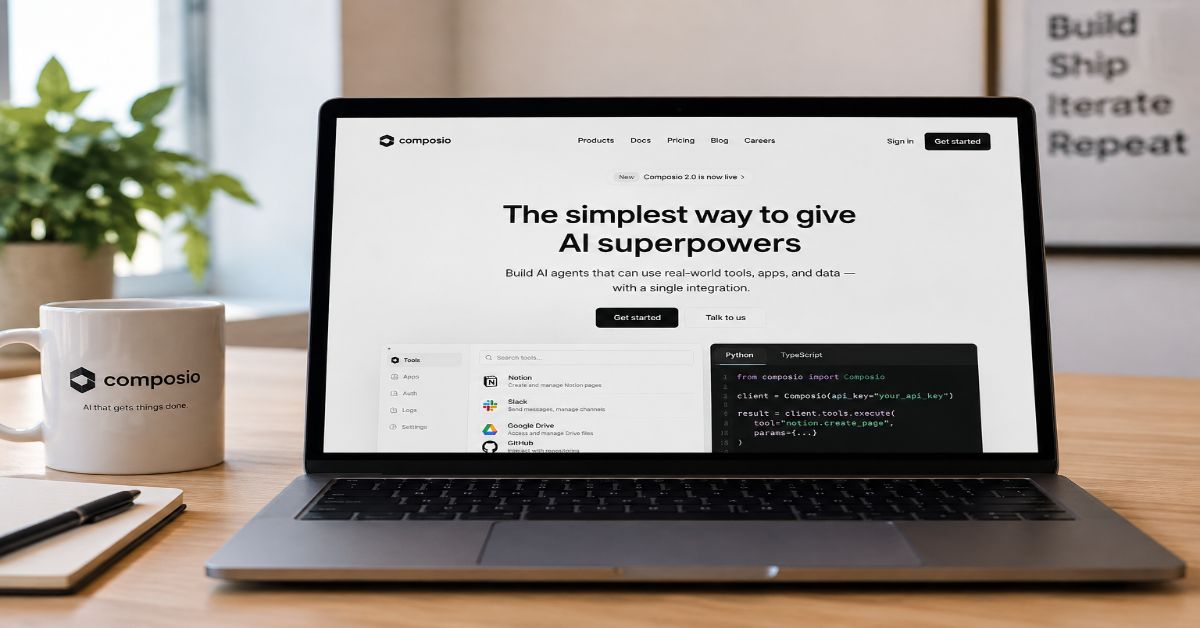
An AI agent can write a polished plan in seconds, then fail at the moment that matters: actually sending the email, updating the CRM, opening a GitHub issue, or reacting to an event. I see that gap as the real integration problem in agent development. Composio is designed to close it by giving agents a managed layer for discovering tools, authenticating users, executing actions, handling triggers, and working across a large catalog of connected applications.
If you searched for Composio because you want to know what it is, how it works, whether it fits your agent stack, and what it costs, this guide answers those questions in practical terms. The short answer is that Composio is infrastructure for connecting AI agents to external software. Instead of hand-building OAuth flows and individual API wrappers for every service, a developer can create a user-scoped session and let the agent discover and execute the tools it needs.
What makes the platform more interesting than a simple integrations directory is its runtime model. Current Composio documentation describes sessions that scope connected accounts, available tools, authentication, and execution state to a particular user. It also supports SDK integrations, hosted MCP access, triggers, and a sandboxed workbench. That means the important design question is not merely “How many apps can it connect?” but “Can it give an agent the right capability, for the right user, at the right moment, without flooding the model with tool schemas?”
In this article, I will break down that architecture, show where Composio reduces engineering work, identify the tradeoffs that still remain yours to manage, and give you a decision framework for choosing it for production agent systems.
What Is Composio?
Composio is an integration and tool-execution platform for AI agents. Its current documentation positions the product around tool discovery, per-user authentication and context, action execution, triggers, and sandboxed code execution across more than 1,000 app integrations. The exact catalog count can change as the service adds toolkits, so the durable point is the architecture: one agent-facing layer can broker access to many external services.
For a developer, the core value is abstraction. A conventional integration often requires an OAuth implementation, token storage and refresh logic, API-specific schemas, error handling, and a way to expose the resulting operations to an LLM. Composio centralizes much of that plumbing and presents tools through its SDKs, APIs, CLI, or Model Context Protocol connections.
Primary references for the current product behavior are the Composio documentation, API reference, and official GitHub repository.
How Does Composio Work?
The cleanest way to understand Composio is to follow a request from the user to the external app. The agent starts with a session associated with an application user. That session determines which connected accounts and toolkits are in scope. The agent can then discover a relevant tool, request authentication when a connection is missing, execute the action, and use the result in the next reasoning step.
Composio’s current quickstart emphasizes a small set of runtime or meta tools rather than loading hundreds of application schemas into the model context at once. This is an important design choice. Tool-heavy agents can waste context window capacity and make poorer selections when every possible operation is presented simultaneously. Just-in-time discovery narrows the choice set around the user’s intent.
The workflow can be summarized like this:
Create or resume a session for a specific application user.
Let the agent search for the capability needed for the current task.
Authorize the relevant external account if the user has not connected it.
Load the required tool schema only when it is needed.
Execute the action against the connected service.
Return the result to the agent and continue the workflow.
Optionally listen for triggers so external events can start or continue agent work.
This table maps the main Composio concepts to the engineering problem each one addresses.
| Composio concept | What it does | Why it matters |
| Session | Scopes tools, connected accounts, authentication, and runtime context to a user. | Helps prevent one user’s integrations from becoming another user’s execution context. |
| Tool discovery | Finds relevant actions based on the task instead of exposing the entire catalog. | Reduces context overhead and tool-selection noise. |
| Connected account | Represents an authorized user’s account for an external service. | Separates application users and their credentials. |
| Auth config | Defines authentication scheme, scopes, and credentials for a toolkit. | Centralizes OAuth/API-key configuration and lets teams control requested access. |
| Trigger | Subscribes to events from supported toolkits. | Enables event-driven agents instead of prompt-only workflows. |
| Workbench / sandbox | Runs code in an isolated environment with connected tools available. | Supports multi-step processing when a single API call is not enough. |
| MCP endpoint | Exposes a session to MCP-compatible clients. | Lets existing agent clients consume Composio capabilities without a bespoke adapter. |
What Can You Build With Composio?
Composio is most useful when an agent must cross the boundary from language generation into authenticated software actions. A support copilot that only drafts a reply may not need it. A support agent that reads a ticket, checks an order, updates a CRM record, and posts an escalation to a team channel is much closer to its sweet spot.
Common Composio use cases
Personal or executive assistants that work with email, calendars, documents, and task systems.
Developer agents that create issues, inspect repositories, update project trackers, or coordinate engineering workflows.
Sales and operations agents that move information between CRM, messaging, spreadsheets, and internal systems.
Event-driven automations that react to new messages, payments, issues, or other toolkit triggers.
MCP-based setups where a coding agent or desktop client needs one connection for access to multiple apps.
A useful way to evaluate these scenarios is to count integration boundaries. If a workflow touches one stable API, direct integration may be simpler. If it touches five services, supports many end users, and must manage separate credentials for each person, the operational burden grows quickly. That is where an integration layer can create leverage.
Why Do Developers Use Composio Instead of Direct APIs?
Direct APIs give maximum control, but that control comes with recurring integration work. Each provider has its own authorization flow, scopes, pagination, rate limits, error conventions, schema changes, and token lifecycle. Composio does not make those upstream realities disappear, but it gives the agent application a more consistent interface for reaching them.
The strongest advantage is not “fewer lines of code” in isolation. It is the reduction in integration surface area your team must own. Authentication, user-to-account mapping, tool discovery, and framework adapters are cross-cutting concerns. Centralizing them can make it easier to add a new app without redesigning the entire agent runtime.
The tradeoff becomes clearer in a direct comparison.
| Decision factor | Composio | Direct API integration |
| Initial setup | Faster when supported toolkits already cover the required apps. | More engineering for auth, wrappers, schemas, and agent tool definitions. |
| Multi-app expansion | Consistent session and tool layer across many services. | Each new service becomes a separate integration project. |
| Authentication | Managed auth configs and connected accounts. | You design token storage, refresh, consent, and account mapping. |
| Control | High at the agent layer, but mediated by Composio’s platform and toolkit model. | Maximum control over every request and provider-specific feature. |
| Dependency profile | Adds a platform dependency and its pricing/limits. | Adds internal maintenance burden and direct provider dependencies. |
| Best fit | Multi-tool agents, many users, rapid integration expansion. | Narrow integrations, unusual APIs, or teams needing complete low-level control. |
How Does Composio Handle Authentication?
Authentication is one of the most consequential parts of an agent integration because a tool call can create real-world side effects. Composio uses auth configs as reusable blueprints for how a toolkit authenticates. Its documentation lists OAuth 2.0, API key, bearer token, and basic authentication among supported schemes. When a user connects an account, Composio creates a connected-account record tied to that user context.
The practical benefit is separation of concerns. Your product can identify the user, while the integration layer handles the provider-specific authorization flow and credentials needed to execute approved tools. Teams can also use their own OAuth clients when they need custom branding, scopes, or provider quotas rather than relying solely on managed credentials.
This does not eliminate your security responsibilities. You still need a deliberate authorization model inside your application. Restrict which toolkits a session may use, request the narrowest useful scopes, validate destructive actions, keep human approval for high-impact operations, and treat tool outputs as untrusted external data.
How Do Sessions and MCP Change the Agent Architecture?
Sessions are central to the current Composio architecture. The API reference describes a session as the runtime context an agent uses for one user, including connected accounts, available tools, authentication behavior, and execution state. In the SDK, developers create a session and can later resume it, which is useful for multi-turn agents.
MCP provides another access path. Current Composio guidance favors session-based MCP endpoints for applications, while Composio Connect offers a shared MCP server for compatible clients. This matters because MCP can decouple the agent client from a custom integration SDK. A compatible client can speak a standard tool protocol while Composio handles discovery and connections behind it.
The architecture choice is therefore straightforward: use the SDK when Composio is part of your application runtime and you want programmatic session control; use a session MCP endpoint when your agent environment already speaks MCP; use the CLI or native agent integrations when the primary user is a developer working from a terminal or coding agent.
Which Frameworks and Languages Does Composio Support?
The official repository currently publishes TypeScript and Python SDKs plus provider adapters for major agent ecosystems. Listed adapters include OpenAI and OpenAI Agents, Anthropic and Claude Agent SDK, Vercel AI SDK, Google tooling, LangChain/LangGraph, LlamaIndex, CrewAI, AutoGen, Mastra, and others. The catalog evolves, so the repository and framework documentation should be checked before implementation.
There are also runtime requirements worth checking early. The current quickstart states that the Python SDK requires Python 3.10 or newer. It also notes that the current TypeScript SDK is ESM-only and requires a recent Node.js 22 release. These are small details until they collide with an older production stack, so I would verify them before choosing an integration path.
What Does Composio Cost?
Composio uses a usage-based model with free, paid, and enterprise tiers. Pricing changes more often than architecture, so the official pricing page should be treated as the source of truth rather than a copied figure in a long-lived implementation document.
As of September 2026, the public pricing page lists a Free tier at $0 with 100,000 tool calls per month, 50,000 triggers per month, unlimited connected accounts, and three team members. The Pro tier is listed at $29 per month and includes $29 in monthly usage credit plus unlimited team members and spend controls. Enterprise pricing is custom and advertises features such as committed-volume discounts, KMS, SSO/SCIM, contractual terms, and dedicated support.
For cost planning, the important unit is not just the subscription price. Model how many agent tasks you expect, how many external tool calls each task produces, how many trigger events flow through the system, and whether retries or multi-step plans multiply execution volume.
This simple planning table helps turn an agent workflow into a cost and reliability estimate.
| Question to measure | Example metric | Why track it |
| How many agent tasks run? | Tasks per user per day | Establishes the base workload. |
| How many tools does one task call? | Median and 95th percentile tool calls | Shows how quickly usage can scale beyond user-message count. |
| How often do tools retry? | Retry rate by toolkit/action | Reveals hidden cost and reliability problems. |
| How many events arrive? | Triggers per connected account | Important for event-driven agents. |
| How often is human approval required? | Approval rate for write/destructive actions | Measures safety friction and workflow design quality. |
| How often does auth fail? | Connection and token-refresh failure rate | Highlights user-experience and provider issues. |
What Are the Main Benefits and Limitations of Composio?
Benefits that matter in production
The biggest benefit is faster expansion across external services without recreating the same integration primitives. Per-user sessions make the user boundary explicit. Managed authentication reduces repeated OAuth work. Runtime tool discovery can keep the agent’s context smaller than a design that loads every schema up front. Framework adapters and MCP support also give teams more than one way to fit the platform into an existing stack.
Limitations you should plan for
Composio is still an abstraction over third-party APIs. If an upstream provider changes behavior, rate-limits an account, revokes a token, or exposes an incomplete capability, your agent can still fail. A supported toolkit may also not expose every niche endpoint or provider-specific feature you need. For unusual integrations, direct API access or a custom tool may remain necessary.
There is also platform concentration risk. Moving auth, tool schemas, and execution through one service makes development easier, but it creates another dependency in your production path. Before committing, test failure behavior, logs, rate limits, data handling, regional or compliance requirements, export/migration paths, and how easily critical tools can fall back to direct integrations.
How Should You Evaluate Composio for a Production Agent?
I would not evaluate Composio by counting integrations alone. A better test is to build one representative workflow with real user boundaries and real failure cases. Pick a task that requires at least two external services, one authentication step, one write action, and one recoverable error. That exposes the operational qualities that a demo can hide.
Confirm that the exact actions you need exist and that their schemas expose the required fields.
Test account connection, reconnection, revoked consent, expired credentials, and multiple accounts for the same toolkit.
Restrict the session to the minimum toolkits and permissions required for the workflow.
Measure tool-search accuracy and the number of tool calls per successful task.
Add explicit confirmation before irreversible, financial, public, or destructive actions.
Test provider errors, timeouts, rate limits, malformed outputs, and duplicate execution.
Review logs and observability to make sure you can explain why an action occurred.
Estimate monthly tool-call and trigger volume from production-like traces, not optimistic demos.
A successful proof of concept should demonstrate more than task completion. It should show that the system can attribute every action to the correct user, recover from a failed connection, avoid duplicate writes, and expose enough telemetry to debug a bad outcome. Those are the signals that an agent integration layer is ready to move beyond experimentation.
When Is Composio the Right Choice?
Composio is a strong candidate when you are building an agent that must act across several SaaS products, serve many end users with separate accounts, or add integrations faster than a small engineering team can maintain bespoke connectors. It is especially relevant when tool discovery and authentication are becoming core infrastructure rather than incidental features.
It may be unnecessary when your product only needs one or two stable APIs, when you require provider features not represented in the toolkit, or when compliance and architecture rules require direct control of every credential and network request. In those cases, the extra abstraction may not earn its place.
The practical decision is not “Composio versus APIs.” Composio itself ultimately reaches APIs. The decision is where you want the integration complexity to live: inside your codebase or behind a specialized agent-tool layer.
Conclusion: The Key Takeaway on Composio
Composio addresses a specific bottleneck in agent development: turning model intent into authenticated, user-scoped actions across external software. Its sessions, managed authentication, runtime tool discovery, triggers, SDK adapters, MCP support, and sandbox capabilities can remove a substantial amount of repetitive integration work.
The strongest implementation pattern is selective rather than automatic. Use Composio where standardized integration plumbing gives you leverage, keep high-risk actions behind explicit controls, and retain direct integrations where you need unusual provider features or tighter infrastructure ownership. If a production test proves correct user isolation, reliable execution, observable failures, and acceptable usage economics, Composio can become a useful action layer rather than just another agent framework dependency.
Frequently Asked Questions About Composio
Is Composio open source?
The official Composio SDK monorepo is publicly available on GitHub under the MIT license. The hosted platform and managed services are separate from simply using or inspecting the open-source SDK code.
Does Composio support MCP?
Yes. Composio supports MCP-compatible access, including session-based hosted MCP endpoints. Its documentation also describes Composio Connect for connecting compatible clients to a shared MCP endpoint.
Can Composio manage OAuth for multiple users?
Yes. Composio’s model uses auth configs and connected accounts so individual application users can authorize their own external accounts. Sessions then scope the agent’s runtime context to the relevant user.
Do I need Composio if I already use LangChain or OpenAI Agents?
Not necessarily, because those frameworks can call tools you build yourself. Composio serves a different layer: it supplies integrations, authentication, discovery, and execution, and it offers adapters for agent frameworks so you do not have to implement every external tool independently.
Can I use my own OAuth credentials with Composio?
Yes. Composio documentation describes custom auth configs for teams that need their own OAuth client, custom consent branding, scopes, or provider-specific quota rather than a managed app configuration.
What should I test before deploying Composio in production?
Test the exact tool actions you need, per-user account isolation, revoked or expired authentication, retries and duplicate writes, provider rate limits, approval gates for sensitive actions, observability, and realistic tool-call volume. A successful happy-path demo is not enough for an action-taking agent.
Sources and Verification Notes
Composio Authentication / Auth Configs
Composio Official GitHub Repository
Product capabilities, toolkit counts, runtime requirements, and pricing can change. The factual product details in this article were checked against the official sources above in September 2026.

A domain name can make a promise before a page even loads. When I opened techtrendery.com and reviewed its homepage, About page, and active category archives on September 16, 2026, I expected a narrowly focused technology publication. What I found was a much broader editorial site: technology sits near the center, but readers can also move into business, education, finance, digital marketing, social media, health, news, real estate, and practical consumer topics. That matters because a search for the domain itself is usually navigational. The person typing the name is not asking for a dictionary definition; they want to reach the website, understand what kind of content lives there, and decide where to begin.
This guide answers that need directly. I have treated the live site structure as the primary evidence, rather than relying on the brand name alone. The current homepage surfaces articles from several categories, while the Technology and Tech archives contain material on AI tools, software, hardware, cybersecurity, mobile apps, industrial systems, productivity, and digital operations. Other archives expand the range further, including SEO and email design in Digital Marketing, trading and small-business topics in Business, academic guidance in Education, and platform-focused explainers in Social Media.
One detail is especially useful for readers assessing the site: the About page still presents TechTrendery mainly as a platform for biographies and life stories, while the live publishing mix has clearly evolved beyond that description. The safest way to understand techtrendery.com in 2026 is therefore to judge it by its current categories, article dates, authorship, and topic-specific evidence on each page. This article shows exactly how to do that.
Direct answer: techtrendery.com is an active multi-topic publishing website with a strong technology and practical-guides core. Its current content spans Tech, Technology, Business, Education, Finance, Digital Marketing, Social Media, News, Health, and related categories, so the fastest way to use the site is to enter through the category closest to your question and then evaluate the freshness, author, scope, and sourcing of the individual article.
What is techtrendery.com?
Techtrendery.com is best understood as a general-interest digital publication with a technology-forward identity. The homepage currently mixes posts from multiple editorial categories instead of operating as a single-topic software, gadgets, or startup blog. That distinction is important because the domain name may lead a new visitor to expect only technology news, while the actual site functions more like a broad magazine of explainers, service guides, business topics, digital trends, and consumer information.
The site is also actively publishing. On the homepage reviewed for this article, recent posts were dated September 14 to September 16, 2026, and appeared under categories including Education, News, Tech, Technology, and Health. The separate Tech and Technology archives show that the publisher treats those two labels as distinct sections, even though their subject matter can overlap. For a reader, that means navigation by topic is more reliable than trying to infer the site taxonomy from the brand name alone.
What topics does techtrendery.com cover?
The current editorial footprint is wide enough that a simple label such as “technology blog” would undersell it. The table below maps the main sections I verified and the kind of reader need each one appears designed to serve.
| Section | Typical coverage observed | Best fit for readers looking for |
| Tech | Software, cybersecurity, mobile apps, hardware, industrial systems, productivity tools | Applied technology and business-tech guidance |
| Technology | AI workflows, app localization, retail technology, wearables, property software, electrical and technical guides | Technology use cases, tools, and implementation topics |
| Business | Trading, loans, events, employee processes, cash automation, travel-related business guidance | Operational, financial, and business decision support |
| Digital Marketing | Local SEO, backlinks, email design, CRM data | Marketing, search visibility, and customer-data topics |
| Education | School transport, tutoring, grades, kindergarten, study support | Learning, academic services, and education planning |
| Finance | Creator income, retirement tax topics, payment processing, borrowing | Money, payments, and personal or business finance explainers |
| Social Media | Instagram, TikTok, Telegram, browsers, video saving, audience growth | Platform tools, content workflows, and social-media how-tos |
| News and other categories | Robotaxis, health topics, real estate, and timely practical stories | Broader current-interest and lifestyle information |
This breadth creates two practical consequences. First, returning visitors should bookmark the categories they actually use instead of relying on the homepage feed. Second, readers should assess expertise at article level. A publication that covers many unrelated subjects can still host useful work, but the quality signal comes from whether a specific article defines its scope, cites relevant evidence, names products or standards accurately, and avoids claims that outrun its sources.
Why do “Tech” and “Technology” both appear on the site?
The site currently maintains separate Tech and Technology archive pages. Their boundaries are not rigid: both can include software, AI, hardware, business systems, and digital tools. The Tech section I reviewed included desktop organization software, HMI/SCADA software, cyber resilience, mobile apps, nonprofit accounting software, and hardware prototyping. The Technology section included AI tools, app localization, retail technology, wearable technology, property-management software, and technical service topics.
From a navigation standpoint, the duplication is less confusing if you treat both sections as complementary technology feeds rather than expecting a textbook taxonomy. Search engines and AI systems also benefit when an individual article uses precise entities in its title and headings. A page about HMI/SCADA software or app localization is easier to understand and retrieve than one that depends only on a broad category label.
How should a first-time visitor use techtrendery.com?
A first visit is easier when you start with your task rather than scrolling the entire homepage. I use a simple three-stage process for broad publication sites: identify the category, check the article’s publication context, then verify the claims that matter to a real decision. The table below turns that into a quick workflow.
| Your goal | Where to start | What to verify before relying on the page |
| Learn about a tool or technology | Tech or Technology archive | Product/version names, dates, technical limits, linked documentation |
| Solve a marketing problem | Digital Marketing or Social Media | Platform rules, current feature availability, examples, privacy or policy limits |
| Research a business or finance topic | Business or Finance | Jurisdiction, dates, fees, tax or regulatory assumptions, primary sources |
| Find education guidance | Education | Location, school level, curriculum context, whether claims apply to your situation |
| Read a timely story | News or homepage | Publication date, event date, named sources, whether newer information exists |
| Explore generally | Homepage, then category archives | Author, category fit, internal links, and the article’s stated scope |
What should you check before trusting an article?
Trust is not an all-or-nothing property of a domain. For a multi-topic site, the better approach is to judge each page according to the consequences of acting on it. A desktop-productivity story can be useful with first-hand observations and accurate product details. A financial, health, legal, safety, or security article needs a much higher evidence threshold because outdated or incomplete guidance can have real costs.
Check the date and the subject’s rate of change
Freshness should match the topic. An article about a stable concept can remain useful for years, while an article about social-platform features, software versions, immigration rules, tax treatment, AI tools, or cybersecurity can age quickly. Techtrendery.com displays publication dates on article cards and archive pages, which gives readers an immediate first check. When the topic changes fast, compare the publication date with the latest primary documentation before acting.
Separate reported facts from recommendations
A good article makes it clear when it is describing a product, explaining a process, comparing options, or recommending a choice. Readers should look for concrete criteria rather than broad praise. For example, a software comparison is stronger when it specifies platform support, workflow fit, deployment needs, or limitations. A finance article is stronger when it states the jurisdiction and assumptions instead of presenting a general rule as universal.
Look for evidence that matches the claim
The source should be proportionate to the claim. Product documentation is appropriate for feature availability. Government or regulator pages are stronger for compliance, taxes, visas, and safety rules. Peer-reviewed or clinical sources are more appropriate for medical claims. A company’s own marketing page can document what the company says its product does, but it should not be treated as independent proof of performance. This distinction is central to E-E-A-T because authority comes from evidence, not merely confident wording.
Does techtrendery.com match its About page?
Not perfectly, based on the pages available when I reviewed the site. The About page describes TechTrendery as a platform focused on biographies of influential figures, historical icons, innovators, artists, leaders, and other notable people. The current homepage and active category archives, however, show a broader publishing model centered on technology, business, education, finance, digital marketing, social media, health, news, and service-oriented explainers.
The most reasonable interpretation is that the site’s editorial scope has expanded while the About copy has not fully caught up. For readers, this is not a reason to dismiss the site, but it is a reminder to use current navigation and article-level signals as the source of truth. For the publisher, updating the About page would make the brand entity clearer for humans, search engines, and generative systems that rely on consistent self-description.
How does techtrendery.com perform for search and AI discovery?
The site already uses several structural elements that help conventional search and answer engines understand pages: descriptive article titles, category archives, visible dates, author names, and frequent question or problem-led topics. Many recent posts also open with a clear problem statement or key takeaways. Those patterns are useful because they reduce the work a search engine or generative system must do to infer the subject of a page.
The larger opportunity is entity consistency. The domain brand, About page, categories, and article topics should tell the same story about what TechTrendery is. When a site’s self-description says “biographies” but its live content is dominated by technology and practical guides, retrieval systems receive mixed signals. A revised About page, clearer category definitions, stronger author bios, and topic-specific sourcing would improve both human trust and machine attribution without requiring keyword stuffing.
What makes an article on TechTrendery genuinely useful?
Useful content is specific enough to change what the reader does next. On a site with this much topical variety, that means an article should do more than describe a subject. It should define the problem, state who the guidance applies to, identify limits, and give the reader a way to verify the most consequential points.
The following quality signals are especially valuable on a multi-topic publication because they make expertise visible instead of implied.
| Quality signal | Why it matters | What strong execution looks like |
| Clear scope | Prevents advice from being applied too broadly | Names audience, location, product class, or use case early |
| Specific evidence | Makes claims checkable | Links to official docs, standards, regulators, or primary data when relevant |
| First-hand detail | Shows real interaction with the subject | Explains setup, testing conditions, workflow steps, or observed limitations |
| Current dates | Reduces stale guidance | Separates publication date from event date and notes version-sensitive details |
| Transparent limitations | Builds trust | States what was not tested, what varies by jurisdiction, or where expert advice is needed |
| Author context | Helps readers assess experience | Bio explains relevant background for the topic rather than generic authority |
These checks also support AEO and GEO. A self-contained paragraph that defines the topic, names its conditions, and cites the right evidence is easier for an answer engine to extract accurately. The same paragraph is also more useful to a human reader because it does not depend on vague context elsewhere on the page.
Who is techtrendery.com most useful for?
The site is most useful for readers who prefer accessible explainers and practical overviews across several everyday digital and business topics. Technology readers can use it as a discovery layer for tools and concepts. Small-business readers can find operational and marketing topics. Students and parents can browse education articles. Social-media users can find platform-oriented guides, while finance readers can use relevant posts as starting points for further research.
It is less suited to readers who expect a tightly specialized trade journal with one narrow editorial beat. Because the site publishes across many categories, depth will naturally vary by article. That makes the individual page, not the domain label, the right unit of evaluation. For low-stakes learning, a clear explainer may be enough. For spending, compliance, health, finance, cybersecurity, or other high-impact decisions, use the article to frame the question and then confirm critical details with authoritative primary sources.
Where should techtrendery.com improve for stronger E-E-A-T?
The biggest improvement would be alignment. The current About page should describe the publication that visitors actually see in 2026. Clearer category descriptions would also help distinguish Tech from Technology and explain how Business, Finance, News, and other sections fit under the brand. Stronger author pages that connect writers with topic-specific experience would make expertise easier to evaluate.
A second improvement is source visibility. On fast-changing or high-stakes topics, placing primary references close to the relevant claim would make articles easier to audit and more useful to AI systems that need explicit attribution. Finally, consistent editorial notes for testing, sponsored content, affiliate relationships, or contributed articles would help readers understand how a piece was produced. These are not cosmetic SEO tactics. They are trust infrastructure, and trust is what allows a broad publication to cover diverse topics without becoming vague or interchangeable.
Key takeaway
Techtrendery.com is currently a broad, active publication with technology at its center but not at its boundary. The practical way to use it is to navigate by category, read the date and author context, judge evidence at article level, and apply a higher verification standard when the topic affects money, health, safety, security, or compliance. The site’s strongest next step is to align its About page and editorial identity with the much wider content mix readers already encounter.
Frequently asked questions about techtrendery.com
Is techtrendery.com only a technology website?
No. Technology is a major part of the current site, but the live archives also include Business, Education, Finance, Digital Marketing, Social Media, News, Health, Real Estate, and other practical topics. Readers should use the category archives to narrow the site to their interests.
Is techtrendery.com still publishing new content in 2026?
Yes. When reviewed on September 16, 2026, the homepage displayed newly published articles dated September 14, September 15, and September 16, showing active publishing across several categories.
Why does the About page describe biographies when the site covers other topics?
The About page appears to reflect an earlier or narrower brand description. The current homepage and archives show that the editorial scope has expanded substantially. For an up-to-date view of the site, rely on current categories and recent posts while treating the About copy as something the publisher may need to refresh.
How can I find technology content on techtrendery.com?
Start with both the Tech and Technology category archives. The two sections overlap but together cover software, AI, mobile apps, cybersecurity, industrial systems, hardware, productivity tools, and other technology-related subjects.
Should I rely on TechTrendery for financial, health, or legal decisions?
Use relevant articles as a starting point, not as a substitute for authoritative or professional guidance. Verify high-impact claims with current regulators, government sources, official product documentation, qualified professionals, or other primary sources appropriate to the subject.
What is the best way to judge whether a TechTrendery article is trustworthy?
Check the publication date, author context, scope, named evidence, and whether the sources match the claim being made. The more a decision affects money, safety, health, security, or compliance, the stronger the evidence standard should be.

A new word can look familiar enough to feel obvious, yet still lead you in the wrong direction. That is exactly what happens with badgement. I checked how the term is being used across current web pages and compared that usage with the language used by established digital credential standards. The result is clear: badgement is not a formal standards term with one fixed definition. It is used informally to describe badge-related activity, sometimes meaning the creation and use of identification badges and sometimes referring to digital badges that recognize an achievement, skill, role, or status.
If you searched for badgement because you want the meaning, the practical answer is to read the surrounding context. A staff ID badge, event name badge, digital achievement badge, and standards-based Open Badge can all be described by writers using this word, but they are not the same thing. For education, training, HR, professional development, and credential technology, the more precise terms are usually digital badging, digital credentials, microcredentials, or Open Badges.
That distinction matters because a visual badge can be little more than an image, while a standards-based digital credential can carry structured information about the issuer, recipient, achievement criteria, evidence, issue date, and verification method. This guide explains what badgement can mean, how to distinguish physical and digital uses, what makes a digital badge verifiable, and how organizations can choose terminology and systems that remain clear to learners, employees, employers, and software platforms. That is why I treat the word as a doorway into a more precise decision, not as a technical label to copy into policy, procurement, or credential design.
Quick answer: Badgement is an informal, non-standard term for badge-related creation, issuance, use, or recognition. In professional learning and digital credentialing, use more precise language such as digital badging, digital credential, microcredential, or Open Badge when accuracy and interoperability matter.
What does badgement mean?
The safest definition of badgement is broad: it refers to the practice or system of using badges for identification, recognition, access, branding, or proof of achievement. The exact meaning changes with the setting. A conference supplier may use it for printed name badges, an employer may use it for ID cards, and a learning platform may use it when talking about achievement badges.
That flexibility is also the term’s weakness. The word does not tell you whether a badge is physical or digital, whether it can be verified, whether it represents a skill, or whether it follows a technical standard. For readers, buyers, and program owners, the better question is not only ‘What is badgement?’ but ‘What kind of badge is being described, and what can that badge prove?’
This context table separates the most common uses without forcing them into one technical definition.
| Context | What badgement may refer to | More precise term |
| Events and hospitality | Printed or reusable name badges used to identify attendees or staff | Name badge or event badge |
| Workplace access | Photo ID cards, access badges, or badge-based entry systems | Employee ID or access credential |
| Education and training | Badges awarded for completing learning, demonstrating a skill, or meeting criteria | Digital badge or microcredential |
| Professional recognition | Portable proof of certification, competency, membership, or achievement | Digital credential |
| Standards-based ecosystems | Machine-readable, verifiable achievement credentials built to an interoperability standard | Open Badge |
Is badgement the same as digital badging?
No. Digital badging is a clearer and more established phrase for issuing digital badges that represent achievements, competencies, participation, or other forms of recognition. Badgement can be used that way, but it can also include physical identification products or general badge management, so the terms should not be treated as exact synonyms.
What makes a digital badge more than an image?
A badge graphic by itself proves very little. A useful digital badge connects the visual symbol to information that explains what was earned and how it can be checked. In the Open Badges ecosystem, 1EdTech describes a badge as a verifiable, shareable digital credential with structured metadata. Open Badges 3.0 can identify the issuer, earner, achievement, criteria, and supporting evidence, and can use cryptographic proofs so the credential can be verified independently.
This is the practical line between decoration and credentialing. If an organization sends a PNG that says ‘Advanced Excel’ but provides no issuer identity, criteria, evidence, or verification path, the recipient has recognition but weak proof. If the badge is bound to a structured credential that can be verified, the same visual symbol becomes a portable claim that another system can inspect.
How do physical badges and digital badges differ?
Both formats can communicate identity or status, but they solve different problems. Physical badges work well when a person must be recognized in a room or granted access to a location. Digital badges are better when an achievement must travel across profiles, learning systems, applications, or employment workflows.
Badgement Guide |
| Feature | Physical badge | Digital badge | Standards-based Open Badge |
| Primary purpose | Visible identification or access | Online recognition or achievement | Portable, verifiable achievement credential |
| Typical format | Plastic, metal, paper, magnetic or RFID card | Image plus platform record | Structured credential plus visual badge |
| Verification | Visual check or access system | Depends on issuer platform | Machine-verifiable credential data and proof |
| Portability | Limited to physical use | Usually shareable online | Designed for exchange across compatible systems |
| Evidence and criteria | Usually minimal | May be included | Can be represented in structured metadata |
| Best fit | Staff, visitors, events, facilities | Courses, communities, recognition programs | Skills, learning, microcredentials, workforce records |
Why does badgement matter in education and work?
The value is not the badge shape. The value comes from making an achievement understandable, checkable, and useful outside the moment it was awarded. A well-designed credential can help a learner show a specific competency, help an employer understand what was assessed, and help an issuing organization preserve the meaning of its recognition after the original course or program ends.
This matters most for achievements that sit between a full degree and an informal compliment. Short courses, safety training, software skills, internal leadership programs, professional development, community service, and competency milestones may be meaningful, yet they are often difficult to represent on a traditional transcript or resume. A digital badge can give these smaller units of learning a consistent label and evidence trail.
What information should a credible badgement system capture?
For a badge to be useful beyond the issuer’s own website, the supporting record should answer basic verification questions. Open Badges 3.0 provides a concrete model for doing this, and W3C Verifiable Credentials 2.0 provides the broader web data model that modern verifiable credentials can align with.
Issuer: the organization or authorized party making the credential claim.
Recipient: the person or entity to whom the achievement is awarded.
Achievement: the skill, competency, completion, certification, or other recognition being asserted.
Criteria: the requirements the recipient had to meet.
Evidence: optional supporting material that helps a verifier understand how the achievement was demonstrated.
Dates and status: issue date, expiration when applicable, and information needed to determine whether the credential is current.
Verification data: a reliable method for confirming that the credential came from the stated issuer and has not been improperly altered.
A key trust point is easy to miss: verifiability does not prove that every claim is objectively true. W3C’s Verifiable Credentials Data Model 2.0 distinguishes technical verification from the verifier’s decision to trust the issuer and rely on the claims. In practice, a cryptographically valid credential from an unknown or unsuitable issuer may still be irrelevant to a hiring or admissions decision.
How does a badgement workflow work?
A sound workflow starts before the badge artwork is designed. The program owner first defines what the badge means, who can earn it, and what evidence is required. Only then should the team decide how to issue, store, share, and verify it.
Define the achievement. Write a precise statement of what the recipient can do, completed, or demonstrated.
Set measurable criteria. Replace vague conditions such as “participated successfully” with requirements that another reviewer can understand.
Choose the badge type. Decide whether the need is physical identification, simple digital recognition, or a verifiable credential.
Create the record. Capture issuer, recipient, achievement, criteria, dates, and evidence in the chosen platform or credential format.
Issue securely. Deliver the badge to the correct recipient and keep the issuer identity under appropriate organizational control.
Enable verification and sharing. Give recipients a stable way to present the credential and give third parties a way to check it.
Maintain the lifecycle. Support expiration, revocation, corrections, and long-term access when those functions are relevant.
How should an organization choose a badgement approach?
The right approach depends on the claim you need the badge to make. A visitor badge does not need the infrastructure of a professional credential. A badge that may affect hiring, promotion, licensing, admissions, or formal skills recognition needs much stronger governance and verification.
Use this decision table to match the system to the consequence of the badge.
| Need | Suitable approach | What to check before launch |
| Identify people on site | Physical name or photo badge | Durability, privacy, access controls, replacement process |
| Recognize low-stakes participation | Simple digital badge | Clear issuer, accurate wording, stable recipient link |
| Recognize assessed skills | Structured digital credential | Criteria, evidence, assessment method, verification |
| Support portability across platforms | Open Badges compatible credentialing | Interoperability, export, wallet support, verification |
| Use credentials in high-consequence decisions | Standards-based credential plus strong governance | Issuer authority, identity checks, revocation, privacy, auditability |
What should buyers ask a digital badgement platform?
Product demos often emphasize templates and sharing buttons because they are easy to show. For serious credentialing, ask questions that reveal what happens after issuance.
Does the platform support Open Badges 3.0, and is that support certified or independently documented?
Can recipients export or move credentials without being locked to one vendor account?
How are issuer identity, recipient identity, revocation, and expiration handled?
Can criteria, evidence, skills alignment, and assessment details be represented clearly?
What happens to verification links if the customer changes vendors or ends a subscription?
Which data is public, which data is private, and what control does the recipient have over sharing?
Can administrators correct errors without silently changing the historical meaning of an issued credential?
What terminology should you use instead of badgement?
Use badgement when you are intentionally discussing the broad idea of badge creation and use, or when you are matching the exact wording people are searching for. In formal documentation, product requirements, procurement, policy, and learner communications, choose the narrower term that describes the object or process accurately.
Use “name badge” for visible personal identification at an event or workplace.
Use “access badge” or “ID credential” when the item controls entry or confirms identity.
Use “digital badge” for online recognition represented by a badge and supporting record.
Use “microcredential” when the credential represents a smaller, focused unit of learning or competency and your institution uses that term consistently.
Use “Open Badge” when the credential conforms to the 1EdTech Open Badges specification.
Use “verifiable credential” when discussing the broader machine-verifiable credential model defined by W3C standards.
This naming discipline improves search clarity and procurement quality. It also prevents teams from comparing products that solve completely different problems, such as an event badge printer and a digital credential platform.
What do current digital credential standards say?
The standards language is more precise than the informal word badgement. 1EdTech’s Open Badges specification defines a method for packaging information about a recognized achievement, including structured metadata. Open Badges 3.0 represents credentials in a format compatible with W3C Verifiable Credentials Data Model 2.0 and supports cryptographic verification. The W3C published Verifiable Credentials Data Model 2.0 as a Recommendation on May 15, 2025.
Open Badges 3.0 also supports richer descriptions of an achievement, including criteria, alignment, and evidence. 1EdTech’s current conformance materials show that certification can cover issuer, displayer, and host functions, which is useful when an organization wants evidence that a product implements the ecosystem requirements rather than merely using the phrase ‘open badge’ in marketing.
For primary-source verification, see 1EdTech Open Badges, Open Badges 3.0 Conformance and Certification, and the W3C Verifiable Credentials Data Model 2.0.
What are the common badgement mistakes?
Most badge programs fail for semantic reasons before they fail for technical ones. If the badge name sounds impressive but the criteria are vague, the credential becomes hard to interpret. If the verification page disappears when a vendor contract ends, portability is only superficial. If every small activity receives a badge, recipients and verifiers may struggle to separate meaningful achievements from routine participation.
Designing the artwork before defining the achievement and assessment criteria.
Treating a shareable image as equivalent to a verifiable digital credential.
Using the same badge for attendance, completion, and demonstrated competency.
Publishing personal information by default without considering recipient privacy.
Ignoring expiration or revocation for credentials that can become outdated.
Choosing a closed platform without planning for export, migration, or long-term verification.
Calling a badge “certified” or “verified” without explaining who verified what.
A useful test is to hand the badge description to someone who did not design the program. If that person cannot explain what the recipient did, how the achievement was assessed, and who stands behind the claim, the credential needs clearer semantics before it needs better graphics.
Conclusion
Badgement is useful as a broad search term because it points toward identification, recognition, and credentialing. It is not precise enough to define a serious badge program by itself. The practical move is to identify the real use case, then switch to the language that matches it: name badge, access badge, digital badge, microcredential, Open Badge, or verifiable credential.
For learning and workforce programs, credibility comes from clear achievement definitions, transparent criteria, trustworthy issuer identity, sensible privacy choices, and verification that survives beyond a screenshot. The badge graphic gets attention, but the structured meaning behind it is what makes the credential useful.
Frequently asked questions about badgement
Is badgement a standard English or technical term?
It is used online, but it is not the formal term used by major digital credential standards. In technical or institutional writing, use a more specific term such as digital badge, Open Badge, microcredential, or verifiable credential.
Can badgement refer to employee ID cards?
Yes. Some people use the word broadly for physical identification badges and badge systems. If access control or staff identification is the subject, “employee ID,” “access badge,” or “ID credential” is clearer.
Can a digital badge be added to LinkedIn or a resume?
Often yes, depending on the issuing platform. The stronger practice is to link to a verification page or credential record so a recruiter can inspect the issuer, achievement, criteria, and status instead of seeing only an image.
Does an Open Badge require blockchain?
No. Open Badges 3.0 is designed around verifiable credential standards and cryptographic proofs, but blockchain is not a requirement for issuing or verifying an Open Badge.
What is the difference between a badge and a microcredential?
A badge is a representation of recognition, while a microcredential usually describes a focused credential tied to a defined learning or competency outcome. An organization can issue a microcredential as a digital badge, but the terms are not automatically interchangeable.
How can I tell whether a badgement platform is trustworthy?
Check the platform’s standards support, verification method, issuer controls, data portability, privacy model, revocation process, and long-term access. For Open Badges claims, look for clear documentation and, where relevant, 1EdTech certification evidence.

A customer in Seoul can expect a 5G-first experience, a shopper in Jakarta may discover a product through short-form video, and a small business in South Asia may still be trying to turn reliable broadband into a daily operating advantage. That contrast is the real story behind Asia Pacific digital growth. I approach the region as a portfolio of connected economies rather than one uniform market, because that is the only way to make sense of its scale, speed, and unevenness.
For someone searching “asia pacific digital,” the practical question is usually not whether the region is becoming more digital. It is what the digital landscape looks like now, which forces are shaping it, and how a business should respond. The short answer is that Asia-Pacific is moving into a phase where connectivity, digital commerce, AI, data infrastructure, and digital public systems reinforce one another, while regulation, affordability, trust, and local consumer behavior keep each market distinct.
The numbers show both progress and friction. The International Telecommunication Union estimated that 77% of people in Asia-Pacific used the internet in 2025, while its regional dashboard reported 5G population coverage of about 70%. Yet GSMA data for June 2025 showed mobile internet subscribers at 85% of the population in developed Asia-Pacific and only 50% in developing Asia-Pacific, where a 47% usage gap remained. In other words, network availability is no longer the whole challenge. Adoption, skills, affordability, relevance, and trust matter just as much.
This guide explains the Asia Pacific digital economy through that lens. It separates infrastructure from actual usage, shows where AI and commerce are creating value, compares subregional priorities, and turns the trends into a practical operating model for companies planning growth in 2026 and beyond.
What does “Asia Pacific digital” mean in 2026?
Asia Pacific digital describes the region’s interconnected digital economy and transformation agenda: the networks, platforms, payments, cloud and data infrastructure, AI systems, digital public services, regulations, and skills that shape how people and organizations operate online. In 2026, the defining feature is not a single technology. It is the convergence of connectivity, commerce, AI, and trusted digital infrastructure across markets that remain highly diverse.
That definition matters because the Asia-Pacific label can hide more than it reveals. Japan, Singapore, South Korea, Australia, China, India, Indonesia, the Philippines, Vietnam, Pakistan, and Pacific island economies do not share the same infrastructure economics, payment habits, language patterns, or regulatory environments. A regional strategy therefore needs common architecture without forcing identical execution.
The following indicators provide a compact view of the region’s current digital baseline.
| Indicator | Latest checkable figure | Why it matters | Source |
| Internet use in Asia-Pacific | 77% of the population in 2025 | Large online reach, but nearly one in four people remained offline | ITU Facts and Figures 2025 |
| 5G population coverage | 70.4% in Asia & Pacific in 2025 | Advanced mobile infrastructure is broad, but coverage does not equal active use | ITU DataHub, 2025 |
| Mobile internet subscribers | 85% developed APAC; 50% developing APAC | Shows the adoption divide inside the same region | GSMA Mobile Economy Asia Pacific 2025 |
| ADB digital infrastructure commitment | $20 billion through the Asia-Pacific Digital Highway by 2035 | Signals long-term investment in connectivity, infrastructure, and skills | Asian Development Bank, June 2026 |
| Southeast Asia digital GMV | More than $300 billion projected for 2025 | Shows the commercial scale of one major APAC subregion | Google, Temasek, Bain, e-Conomy SEA 2025 |
Why is Asia Pacific digital growth accelerating now?
The acceleration comes from several layers maturing at the same time. Broadband and smartphones created the access layer. E-commerce and digital payments built daily habits. Cloud platforms and data centers made digital services easier to scale. AI is now adding an intelligence layer that can change how products are discovered, how operations are automated, and how services are personalized.
Connectivity is shifting from coverage to quality and usage
The next connectivity problem is less about whether a signal exists and more about whether people can afford devices and data, trust online services, and gain enough value to stay active. ITU’s 2025 regional data showed urban internet use in Asia-Pacific at 88.4% compared with 65.9% in rural areas. That gap affects far more than media consumption. It shapes access to digital finance, education, health information, government services, remote work, and online selling.
For businesses, this creates a design rule: do not equate addressable population with serviceable digital demand. A market may have high network coverage while still requiring low-data experiences, lightweight apps, assisted onboarding, local language support, or offline-to-online journeys.
AI is moving from experimentation into the operating model
AI adoption is becoming visible in search, commerce, customer service, coding, fraud detection, logistics, marketing, and content creation. Southeast Asia offers a useful signal. Google, Temasek, and Bain reported in 2025 that consumer interest in AI topics in the subregion was about three times the global average, while more than $2.3 billion had been invested in over 680 AI startups during the previous year. They also reported more than 4,600 MW of planned new data-center capacity in Southeast Asia, with capacity expected to expand faster than the rest of Asia-Pacific.
The strategic implication is bigger than adding a chatbot. Companies need to decide where AI has permission to act, which data it can use, how outputs are reviewed, and what happens when models fail. In customer-facing markets, trust architecture becomes part of product design.
Digital commerce is becoming more embedded and more visual
The region’s next commerce cycle is being shaped by embedded payments, video-led discovery, marketplaces, social platforms, and financial services that sit inside non-financial apps. In Southeast Asia, the 2025 e-Conomy SEA report projected more than $300 billion in digital economy GMV and said video commerce could account for 25% of e-commerce GMV. The same report said more than 60% of payments in the subregion were digital.
That changes the customer journey. Search, entertainment, recommendation, payment, and post-purchase service increasingly happen inside the same digital environment. Brands that still separate media planning, commerce, payments, and customer data into disconnected teams can miss the actual path to conversion.
How do Asia-Pacific digital markets differ by subregion?
A useful regional strategy starts by grouping markets according to operating conditions rather than forcing them into a single maturity ranking. The table below summarizes practical differences that influence go-to-market decisions.
| Subregion or market type | Common digital strengths | Typical friction points | Business priority |
| Developed Asia-Pacific | High smartphone use, advanced 5G, mature cloud and digital payments | High customer expectations, privacy scrutiny, expensive acquisition | Differentiate through experience, trust, and AI-enabled efficiency |
| Greater China | Deep platform ecosystems, advanced mobile commerce, strong digital infrastructure | Distinct platforms, data rules, localization requirements | Build market-specific platform and data strategy |
| India and large South Asian markets | Mass mobile adoption, digital public infrastructure, large SMB base | Language diversity, affordability gaps, uneven digital capability | Design for scale, vernacular use, low-friction payments, and assisted adoption |
| Southeast Asia | Fast digital commerce growth, mobile-first consumers, expanding digital finance | Fragmented languages, regulations, logistics, and payment preferences | Use a regional core with country-level commercial playbooks |
| Pacific island economies | Clear value from digital public services and remote connectivity | Small markets, distance, infrastructure cost, resilience constraints | Prioritize resilient connectivity, shared platforms, and essential services |
This comparison is intentionally operational, not a claim that every country inside a subregion behaves the same way. The point is to make strategy modular. Shared technology, security, analytics, brand standards, and governance can sit at regional level, while product packaging, channels, pricing, content, payments, and partnerships can adapt locally.
What is the biggest strategic mistake in Asia Pacific digital expansion?
The biggest mistake is treating localization as translation. Translation changes words. Real localization changes the product’s fit with the market. That may include identity verification, payment methods, delivery promises, customer support hours, content format, search behavior, app size, data consent flows, and the role of human assistance.
A second mistake is building country-by-country systems with no regional spine. That creates duplicated tooling, fragmented customer data, inconsistent security, and slow learning. The better model is a regional core with local edges: centralize what benefits from scale and standardization, then localize what affects adoption and conversion.
What should sit in the regional core?
Cloud and data architecture, including identity, security controls, observability, and approved AI services.
Measurement standards, with consistent definitions for acquisition, activation, retention, revenue, service quality, and risk.
Reusable product components, design systems, API standards, and experimentation methods.
Governance for privacy, cybersecurity, model risk, vendor assessment, and incident response.
Knowledge sharing, so a learning from one market can be tested elsewhere without copying it blindly.
What should remain local?
Market teams should control the decisions closest to consumer reality: language and creative expression, channel mix, local partnerships, payment options, pricing and promotions, customer service practices, regulatory implementation, and the sequencing of product features. The local edge is where a regional platform becomes relevant enough to earn actual use.
How should businesses build an Asia Pacific digital strategy?
A credible strategy should connect market selection, customer behavior, technology, governance, and economics. The following five-step sequence keeps those elements linked instead of treating digital transformation as a technology shopping list.
1. Segment markets by digital behavior, not just GDP
Group markets using variables such as internet usage, mobile internet adoption, payment habits, platform concentration, language complexity, logistics reliability, and regulatory requirements. This produces more useful clusters than a simple developed-versus-emerging split.
2. Choose one or two customer journeys to win first
Map the full journey from discovery to payment, fulfillment, service, and repeat use. Prioritize journeys where digital can remove measurable friction, not just add a new interface.
3. Build the shared regional spine
Standardize identity, analytics, cloud patterns, security, API governance, experimentation, and AI controls. Shared foundations reduce reinvention and make cross-market learning faster.
4. Give local teams explicit adaptation rights
Define which elements can change without regional approval. Local autonomy works best when the boundaries are written down, measured, and reviewed.
5. Measure adoption and trust alongside revenue
Track conversion and revenue, but also service reliability, complaint rates, fraud, opt-outs, latency, repeat usage, and the share of customers who need assisted support. These measures reveal whether digital growth is durable.
This scorecard turns the strategy into a set of decisions and measurable checks.
| Capability | Key question | Example metric | Warning sign |
| Market fit | Are we solving a locally important problem? | Activation rate by country and customer segment | Strong traffic but weak repeat use |
| Experience | Can users complete the journey on their normal device and connection? | Task completion, latency, app size, abandonment | High support contact for basic tasks |
| Payments and commerce | Do checkout and settlement match local habits? | Payment success rate and checkout conversion | A regional payment option dominates internally but not locally |
| AI and data | Is AI improving a defined outcome within approved controls? | Resolution time, forecast error, fraud loss, human override rate | AI use grows faster than governance and evaluation |
| Trust and resilience | Can the service recover and explain failures? | Incident rate, recovery time, complaints, consent withdrawal | Growth depends on hidden operational workarounds |
Where are the biggest Asia Pacific digital opportunities through 2030?
The strongest opportunities sit where digital infrastructure meets a large unresolved operational problem. That includes AI-enabled business software, digital financial services, cybersecurity, cloud and data-center infrastructure, logistics technology, health and education platforms, digital public infrastructure, and tools that help small businesses sell, get paid, borrow, and manage operations.
Infrastructure investment will remain central. In June 2026, the Asian Development Bank announced a $20 billion Asia-Pacific Digital Highway initiative through 2035. ADB said the program aims to reach 650 million people, help 200 million gain broadband for the first time, improve connectivity for another 450 million, and train 3 million people in digital and AI skills. These targets show why the next phase of digital growth is as much about access and capability as it is about software.
The opportunity is also becoming more institutional. Governments are investing in digital identity, payments, data exchange, public-service platforms, cybersecurity, and responsible AI. Businesses that can integrate with these systems safely may gain distribution and efficiency advantages, but they will also face higher expectations around resilience, privacy, interoperability, and auditability.
What risks could slow the Asia Pacific digital economy?
Four risks deserve board-level attention. First, the usage gap can persist even after networks are built, especially where devices, data, skills, or relevant services remain unaffordable. Second, cyber risk rises as more critical services become connected. Third, inconsistent privacy, data-transfer, platform, and AI rules can increase compliance cost. Fourth, companies can overspend on AI and cloud without redesigning the underlying workflow, producing expensive technology with weak economic impact.
There is also a concentration risk. A company may become too dependent on one cloud, marketplace, app store, social platform, ad network, or payment rail. That can create attractive short-term economics but fragile long-term bargaining power. A resilient digital strategy should identify those dependencies, test alternatives, and decide deliberately where concentration is acceptable.
Conclusion
Asia-Pacific’s digital future will not be won by the company with the longest technology roadmap. It will be won by organizations that can combine common infrastructure with local relevance, move quickly without weakening trust, and measure real adoption rather than celebrating deployment. The region is connected enough for ideas and platforms to travel, but diverse enough to punish copy-and-paste execution.
For decision-makers, the practical takeaway is simple: build the regional core once, then earn each market. That operating discipline is what turns Asia Pacific digital growth from a macro trend into a repeatable business capability.
Frequently asked questions about Asia Pacific digital
Is Asia Pacific digital the same as the Asia-Pacific digital economy?
The phrases overlap, but “Asia Pacific digital” is broader. It can include the digital economy as well as infrastructure, AI, cloud, cybersecurity, public digital systems, regulation, skills, and enterprise transformation across the region.
Which Asia-Pacific markets are most digitally mature?
Singapore, South Korea, Japan, Australia, New Zealand, and parts of Greater China are generally associated with advanced connectivity and digital-service adoption. Maturity still varies by sector, customer segment, and use case, so country-level validation is essential.
Why is the digital divide still important if 5G coverage is high?
Coverage measures whether a network is available, not whether people can afford devices and data, have the skills to use services, or see enough value to adopt them. The region’s usage gaps show why availability and meaningful use must be measured separately.
What role will AI play in Asia-Pacific digital growth?
AI will increasingly shape customer service, software development, marketing, fraud control, forecasting, content discovery, and operations. The strongest use cases will link AI to a measurable workflow outcome and include clear controls for data, evaluation, human review, and failure handling.
How should a company choose its first Asia-Pacific expansion market?
Start with the customer problem and operating fit. Compare demand, acquisition channels, payment behavior, logistics, language needs, regulation, partner availability, and unit economics. A smaller market with better fit can be a stronger launchpad than the largest market by population.
What is the best operating model for multi-country digital growth in Asia-Pacific?
Use a regional core with local edges. Centralize technology foundations, security, data standards, analytics, and governance, while local teams adapt product packaging, channels, content, pricing, payments, partnerships, and service delivery.
-

 Guide3 weeks ago
Voozon.com Guide: What It Is and How It Works
-

 General4 weeks ago
OnlyFans Leaks: How They Happen and How to Reduce the Risk
-

 General4 weeks ago
Spanking Stories: A Reader’s Guide to Themes, Tags and Safer Choices
-

 Technology1 month ago
Listcrawler: How List Crawlers Extract Structured Web Data
-

 Guide1 month ago
How to Run a Marathon: A Practical First-Marathon Guide
-

 General3 weeks ago
SABS Framework Description Paragraph: Practical Guide
-

 Technology4 weeks ago
Coomer.su Explained: Architecture, Data Flow, API Changes and Resilient Client Design
-

 General4 weeks ago
Socialmediagirls Explained: Safety, Privacy, Forum Structure, Leaks and Rules